
Compound hub · Retatrutide
What is the difference between GLP-1 and GLP-3?
GLP-1 means glucagon-like peptide-1, a natural gut hormone, or chemical message. GLP-3 is a nickname for compounds such as retatrutide. These act at GLP-1, GIP and glucagon receptors, the cells' receivers. GLP-3 names no hormone or approved medicine class. Lilly's terminology FAQ, checked 17 October 2026, calls it scientifically inaccurate. Names alone cannot show safety or effects in people.
Form Labs materials are research reference materials, not the approved medicines; no Form Labs product is approved for human or veterinary use.
01GLP-1 and its receiverContents
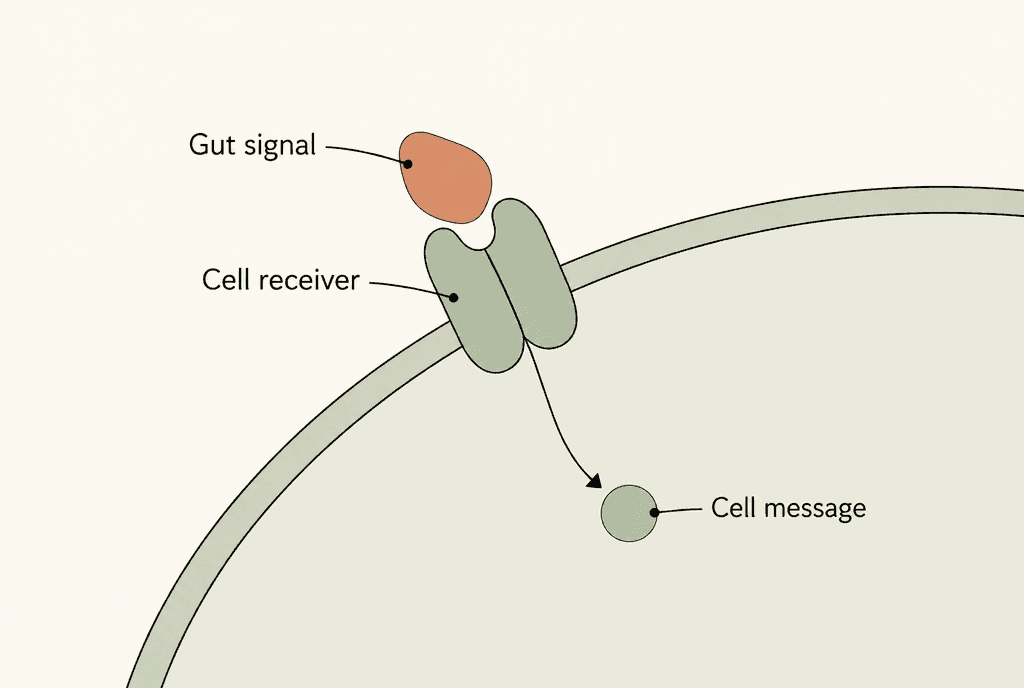
Your gut sends chemical messages through the blood. Cells receive them through proteins called receptors. The message and its receiver have linked names. That can make a short headline hard to follow. The retatrutide hub puts those names beside their source papers and records.
You might also see a number used like a version label. Here, that gives the wrong picture. A hormone name, a receptor name and a nickname mean different things. The retatrutide research guide gives the wider picture. This page explains what the words mean.
Key facts
| GLP-1 | Glucagon-like peptide-1; gut hormone (Thorens, 1992) |
|---|---|
| GLP-1R | GLP-1 receptor; cell-surface receiver (Thorens, 1992) |
| GIP | Glucose-dependent insulinotropic polypeptide (Urva et al., 2022) |
| GCGR | Glucagon receptor (Coskun et al., 2022) |
| GLP-2 | Separate glucagon-like peptide in the starting protein (Bell et al., 1983) |
| GLP-3 label | Nickname; not a scientific class (Lilly FAQ, checked 17 October 2026) |
What is GLP-1, and what is the GLP-1 receptor?
GLP-1 is a hormone released by cells in the gut lining. A hormone is a chemical message. The GLP-1 receptor is a protein that receives that message on a cell's surface. Thorens showed these separate roles in a 1992 study. It appeared in Proceedings of the National Academy of Sciences. The study put a rat receptor into lab cells and tested how they responded. GLP-1 bound to the receptor and switched on a signal inside. This test found a receiver and showed its response. It did not measure lasting health changes in people.
GLP-1R is the short label for that receptor, with the final R meaning receptor. A diagram can show a signal meeting a receiver. In real life, contact depends on the shapes of molecules, not a real key and lock.
Is GLP-3 a hormone or an approved medicine class?
GLP-3 names no hormone or approved medicine class. Lilly's What to know about retatrutide FAQ explains the nickname. This source was checked 17 October 2026. It calls GLP-3 a media label for triple hormone receptor agonists. An agonist is a molecule that switches on a receptor. Triple refers to the targets, not a third version of GLP-1. The nickname is not a scientific class or an approval record. A clear account names the molecule and its receptors, without treating the nickname as a separate body signal.
The guide to the three receptors in the papers looks more closely at what retatrutide does in the body. Naming the targets makes the words easier to check.
What do GIP and glucagon receptors mean?
GIP and glucagon receptors are separate receivers for different hormone messages. GIP means glucose-dependent insulinotropic polypeptide. Urva and colleagues spell this out in The Lancet in 2022. GIPR is the label for its receptor, while GCGR means glucagon receptor. Jelinek and colleagues studied a rat glucagon receptor in Science in 1993. They made lab cells produce this receptor. Glucagon bound to it and set off signals inside the cells. Each name tells the message apart from its receiver. Neither GIPR nor GCGR is another name for the GLP-1 receptor.
Glucagon is part of blood sugar control. Bell and colleagues' 1983 Nature paper describes its role. It prompts the liver to release and make glucose, the sugar in blood. Different hormones can share a role in how the body handles fuel. That does not mean one can take the place of another.
Does GLP-2 belong to the same numbered series?
GLP-2 is a separate peptide name, not a newer GLP-1. Bell and colleagues mapped the human preproglucagon gene in Nature in 1983. A gene carries instructions for making a protein. They found separate regions for glucagon, GLP-1 and GLP-2. These regions were within one larger starting protein, called a precursor. Smaller parts called peptides can be cut from it. The names refer to different parts of that record. A higher number does not mean a stronger medicine or an extra receptor.
Names and shapes answer their own questions about molecules. What is the molecular formula of retatrutide? explains the atoms in a molecule. That is different from naming the receivers it switches on.
Why do papers call retatrutide a triple agonist?
Retatrutide is called a triple agonist because it switches on three receptors. These are the GLP-1, GIP and glucagon receptors. Coskun and colleagues used these names in their 2022 Cell Metabolism discovery paper. The development code was LY3437943. The paper describes one peptide that acts at separate targets. Triple does not mean a mix of natural hormones or name a GLP-3 receptor. The wording tells the molecule apart from the receivers it switches on. A receptor count describes how it works, not its rank.
The guide to compound names, medicine names and receptor targets explains how these labels differ. Keeping them apart makes a comparison easier to read without picking a winner.
Evidence limits
What can the GLP-3 nickname not show?
The GLP-3 nickname cannot show safety, approval or health outcomes. A receptor test asks whether a molecule switches on a cell target. Its findings apply to the test conditions. A study in people asks a different question in a set group. Coskun and colleagues' 2022 discovery paper called for more tests in people. A receptor label cannot predict what happens to one person. These names do not tell you whether a compound works for weight change. That needs the trial record, what it measured and its limits.
This page is part of the education library at Form Laboratories. Research material is not a medicine and is not for human or animal use. A scientific name describes a molecule, but cannot show what is in a real sample.
Comparison
Names and receptor labels in the original sources cited here. The table compares words, not health outcomes.
| Name | What it names | Receptor label | Source |
|---|---|---|---|
| GLP-1 | Glucagon-like peptide-1, a gut hormone | GLP-1R | Thorens, 1992; Coskun et al., 2022 |
| GIP | Glucose-dependent insulinotropic polypeptide | GIPR | Urva et al., 2022; Coskun et al., 2022 |
| Glucagon | A hormone involved in blood sugar control | GCGR | Jelinek et al., 1993; Coskun et al., 2022 |
| GLP-3 | Nickname for molecules that switch on three receptors | No separate receptor named by this nickname | Lilly terminology FAQ, checked 17 October 2026 |
FAQ
What does GLP-1 stand for?
GLP-1 stands for glucagon-like peptide-1. The natural hormone and its receptor are different things. GLP-1 carries the message, and GLP-1R receives it. Thorens' 1992 receptor study shows that difference.
Is GLP-3 another name for retatrutide?
GLP-3 is sometimes used as a nickname for retatrutide. Lilly's FAQ, checked 17 October 2026, calls it scientifically inaccurate. The molecule's name and the term triple agonist are more exact.
Is there a GLP-3 receptor in the retatrutide paper?
The discovery paper by Coskun and colleagues names GLP-1R, GIPR and GCGR. These are separate targets. The paper does not name a separate GLP-3 receiver.
Is GIP the same hormone as GLP-1?
GIP and GLP-1 have different names and different receptors. Urva and colleagues' 2022 paper lists both alongside glucagon. It uses these names to describe which receptors the molecule acts at.
Does triple agonist mean three peptides mixed together?
Triple agonist means a molecule acts at three receptor targets. Urva and colleagues describe LY3437943 as a single peptide. Triple refers to the targets, not separate ingredients.
More in this hub
- Retatrutide vs Mounjaro vs Ozempic: what's the difference?
- Is retatrutide available in the USA? What the public record says
- How much does retatrutide cost? Is there an approved price?
- What does retatrutide do in the body? The three receptors in the papers
- How are people getting retatrutide? Trials, approval and research supply
- Who should not take retatrutide? What the trial exclusion lists say
- What makes a peptide company reputable? How to check a supplier's testing
- What is replacing tirzepatide? Weight-loss medicines in Phase 3 in 2026
- Retatrutide and type 2 diabetes: what the trials measured
- How long has retatrutide been studied?
- Retatrutide pharmacokinetics: what is the half-life?
- Retatrutide Phase 2 trial: what did the paper find?
- What is the molecular formula of retatrutide?
- NCT05882045: what is the TRIUMPH-3 retatrutide trial?
- NCT05929066: what is the TRIUMPH-1 retatrutide trial?
- Where does tirzepatide come from? Lilly's LY3298176
- SURPASS and SURMOUNT: what the tirzepatide trials measured
- Retatrutide in Australia: is it legal, approved or available yet?
- Retatrutide study findings: what do the clinical trials show?
- Retatrutide side effects: what trials and regulators have recorded
Citations
5 sourcesThorens B Proceedings of the National Academy of Sciences. 1992;89(18):8641–8645.
doi:10.1073/pnas.89.18.8641Bell GI, Sanchez-Pescador R, Laybourn PJ, Najarian RC Nature. 1983;304:368–371.
doi:10.1038/304368a0Jelinek LJ, Lok S, Rosenberg GB, et al. Science. 1993;259(5101):1614–1616.
doi:10.1126/science.8384375Coskun T, Urva S, Roell WC, et al. Cell Metabolism. 2022;34(9):1234–1247.e9.
doi:10.1016/j.cmet.2022.07.013Urva S, Coskun T, Loh MT, et al. The Lancet. 2022;400(10366):1869–1881.
doi:10.1016/S0140-6736(22)02033-5
Form Laboratories supplies research-use-only reference material. This article is an educational summary of published third-party literature. It is not medical advice, not a use instruction, and research material is not for human or animal use.