
Compound hub · Retatrutide
What does retatrutide do in the body? The three receptors in the papers
Retatrutide switches on three cell receivers: the GIP, GLP-1 and glucagon receptors. These proteins receive chemical signals on cells. Coskun and colleagues reported this lab finding in Cell Metabolism (2022). It shows how a signal works. It cannot tell you how one person will respond. Human trials must measure results and unwanted effects on their own.
01The receptor namesContents
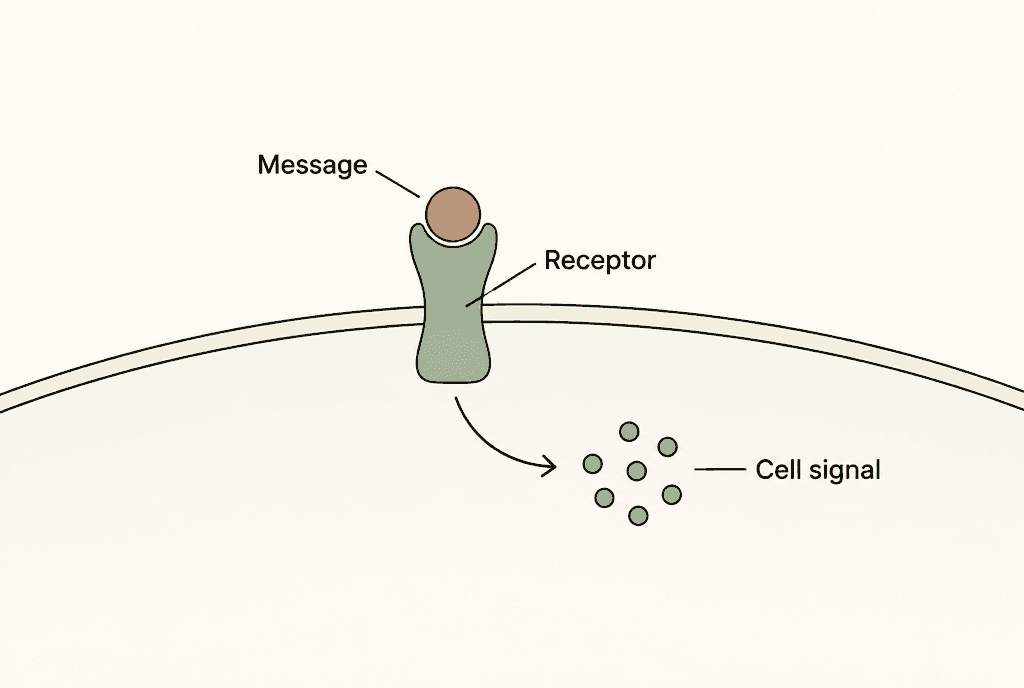
A message needs somewhere to arrive. Your cells have proteins that receive chemical messages. Think of a doorbell that receives a visitor's touch. A paper about these receivers asks one kind of question. A study of people asks another. Explore the wider topic through our retatrutide learning pages.
The retatrutide research guide gives the wider picture. Here, keep three things apart: the signal, the receiver and the study's result. This makes a paper's summary easier to read.
Key facts
| Research code | LY3437943 (Coskun et al., 2022) |
|---|---|
| Receptor targets | GIPR, GLP-1R and GCGR (Coskun et al., 2022) |
| Discovery paper | Cell Metabolism, 2022 |
| Human trial example | Type 2 diabetes study, The Lancet, 2023 |
Which receptors do retatrutide papers name?
Retatrutide papers name the receptors for GIP, GLP-1 and glucagon. GIP means glucose-dependent insulinotropic polypeptide. GLP-1 means glucagon-like peptide-1. Each is a hormone: a chemical message. A receptor is the protein that receives it. Coskun and colleagues named these targets in Cell Metabolism in 2022. An agonist is a substance that switches on a receptor. Triple means three targets. It does not tell you the size of a trial's result. Naming how a signal works starts to explain it. It cannot tell you what will happen to one person.
The question What is the difference between GLP-1 and GLP-3? explains these everyday names. A molecule's identity is a separate topic. See What is the molecular formula of retatrutide?.
What is the GLP-1 receptor?
The GLP-1 receptor is a cell protein that receives the GLP-1 hormone signal. Thorens studied a rat GLP-1 receptor in PNAS in 1992. He took out the genes, the instructions for making that receptor. He placed those instructions in lab cells. Those cells then made the receptor. The tests checked whether GLP-1 attached to it. They also checked for a signal inside the cell. Related hormones did not attach in the same way in that test. This helped show that GLP-1 had a distinct receiver. The work studied cell receivers. It was not a retatrutide trial.
A receptor is part of the receiving cell. A hormone is the message that reaches it. A paper can measure whether a message attaches to a receptor. That does not mean it measures a change in someone's health.
What does a glucagon receptor experiment measure?
A glucagon receptor test can measure attachment and signals inside cells. Jelinek and colleagues studied a copied, or cloned, rat receptor in Science in 1993. Lab cells made the receptor, which attached to glucagon. The team also measured cAMP and calcium changes inside those cells. cAMP is a small chemical messenger that carries a signal within a cell. These readings showed that the receptor could pass a message onward. They did not measure a person's appetite, body weight or long-term health. A cell signal and a human trial result need different tests.
The doorbell example has a limit. Pressing the button and hearing a bell are two separate things. You can find that a molecule attaches to a receptor. Measuring what happens next is a separate step.
What do human retatrutide trials measure?
Human retatrutide trials measure set results and unwanted effects in people. Rosenstock and colleagues' 2023 Lancet study involved people with type 2 diabetes. Its main planned measure was the change in HbA1c at 24 weeks. HbA1c measures sugar attached to haemoglobin. This protein carries oxygen in red blood cells. The study also measured body weight and checked safety. These are measures from a human trial. They do not directly show each receptor's share of a result. A group result cannot tell you what one person will experience.
The question Retatrutide pharmacokinetics: what is the half-life? covers a different measure. It asks how a substance's level in the body changes over time. That is separate from attachment to a receptor or a trial's main result.
Evidence limits
What cannot be concluded from the receptor papers?
A list of receptors cannot tell you what will happen to one person. These papers ask different questions. Thorens studied a GLP-1 receiver. Jelinek and colleagues tested glucagon signals. Rosenstock and colleagues measured results in people. Seeing these findings side by side makes the research clearer. A cell reading still cannot tell you how one person will respond. A trial of a whole molecule cannot show each receptor's separate share of the result. That needs a study built to test each share.
Research material is not a medicine and is not for human or animal use. This page belongs to the education library at Form Laboratories. It explains what the cited tests asked and what their readings can show.
Comparison
Coskun and colleagues named these retatrutide receptors (Cell Metabolism, 2022). The table lists targets. It does not compare results for people.
| Receptor | Receives the signal | Paper's abbreviation |
|---|---|---|
| GIP receptor | Glucose-dependent insulinotropic polypeptide | GIPR |
| GLP-1 receptor | Glucagon-like peptide-1 | GLP-1R |
| Glucagon receptor | Glucagon | GCGR |
FAQ
Is a receptor the same thing as a hormone?
No. A hormone carries a chemical message. A receptor receives that message. Thorens' GLP-1 tests (PNAS, 1992) studied the receiving protein and the hormone separately.
Does triple agonist mean three ingredients?
No. Rosenstock and colleagues (The Lancet, 2023) describe retatrutide as one peptide. It acts at several receptors. Counting the targets does not mean it is a mixture.
Is a cAMP reading a health outcome?
No. cAMP is a messenger inside cells. Jelinek and colleagues (Science, 1993) measured it to study receptor signals. This reading does not show a health result in people.
Can a trial say which receptor caused its result?
No. Testing a molecule that acts at several receptors cannot show each one's share on its own. Rosenstock and colleagues' 2023 trial measured results in people. Read those findings as the results the trial measured.
More in this hub
- Retatrutide vs Mounjaro vs Ozempic: what's the difference?
- What is the difference between GLP-1 and GLP-3?
- Is retatrutide available in the USA? What the public record says
- How much does retatrutide cost? Is there an approved price?
- How are people getting retatrutide? Trials, approval and research supply
- Who should not take retatrutide? What the trial exclusion lists say
- What makes a peptide company reputable? How to check a supplier's testing
- What is replacing tirzepatide? Weight-loss medicines in Phase 3 in 2026
- Retatrutide and type 2 diabetes: what the trials measured
- How long has retatrutide been studied?
- Retatrutide pharmacokinetics: what is the half-life?
- Retatrutide Phase 2 trial: what did the paper find?
- What is the molecular formula of retatrutide?
- NCT05882045: what is the TRIUMPH-3 retatrutide trial?
- NCT05929066: what is the TRIUMPH-1 retatrutide trial?
- Where does tirzepatide come from? Lilly's LY3298176
- SURPASS and SURMOUNT: what the tirzepatide trials measured
- Retatrutide in Australia: is it legal, approved or available yet?
- Retatrutide study findings: what do the clinical trials show?
- Retatrutide side effects: what trials and regulators have recorded
Citations
4 sourcesCoskun T, Urva S, Roell WC, et al. Cell Metabolism. 2022;34(9):1234–1247.e9.
doi:10.1016/j.cmet.2022.07.013Thorens B Proceedings of the National Academy of Sciences. 1992;89(18):8641–8645.
doi:10.1073/pnas.89.18.8641Jelinek LJ, Lok S, Rosenberg GB, et al. Science. 1993;259(5101):1614–1616.
doi:10.1126/science.8384375Rosenstock J, Frias J, Jastreboff AM, et al. The Lancet. 2023;402(10401):529–544.
doi:10.1016/S0140-6736(23)01053-X
Form Laboratories supplies research-use-only reference material. This article is an educational summary of published third-party literature. It is not medical advice, not a use instruction, and research material is not for human or animal use.