
Hub · Peptide Science
Citrullinated peptide antibodies: what anti-CCP is, why the test peptide is cyclic and how it is pronounced
Citrullinated peptide antibodies, called anti-CCP antibodies or ACPA, are antibodies that grab proteins and peptides containing citrulline. Citrulline is an amino acid made when an enzyme edits arginine inside a protein. The anti-CCP test measures how much of this antibody a blood sample holds, using a lab-made ring-shaped peptide as bait. The 2010 ACR/EULAR rules for classifying rheumatoid arthritis give antibody results points in one of four domains.
01CitrullinationContents
Every protein in your body is built from amino acids, and your cells can edit some of them after the protein is made. In your skin and in your brain, an enzyme changes the side chain of one amino acid, and the protein ends up with a slightly different shape and charge. That small edit has a name: citrullination.
This page is part of the peptide science hub. It explains the chemistry behind the anti-CCP antibody test: what citrulline is, why the test uses a ring-shaped peptide, and what the test measures. It describes chemistry and published studies only. It does not read or interpret anyone's result.
Key facts
| Antibody name | Anti-CCP antibody; also anti-citrullinated protein antibody (ACPA) |
|---|---|
| Chemical change | Protein-bound arginine becomes citrulline after the protein is made (Vossenaar et al., 2003) |
| Enzymes | Peptidylarginine deiminases (PADs), calcium dependent (Ishigami and Maruyama, 2010) |
| Test antigen | Lab-made ring-shaped (cyclic) peptide containing citrulline (Schellekens et al., 2000) |
| First test peptide | 19 amino acids from profilaggrin, residues 306 to 324 (Trier et al., 2016) |
| Assay format | Enzyme-linked immunosorbent assay (ELISA) (Schellekens et al., 2000) |
| 2007 meta-analysis, anti-CCP | Pooled sensitivity 67%, pooled specificity 95% (Nishimura et al., 2007) |
| 2010 ACR/EULAR criteria | Serology domain scores 0 to 3; a total of 6 or more out of 10 classifies definite rheumatoid arthritis (Aletaha et al., 2010) |
| Sources checked | 16 October 2026 |
What is citrullination, and which enzymes do it?
Citrullination is a small edit to a finished protein. It turns arginine, one of the amino acids in the chain, into another amino acid called citrulline. Enzymes called peptidylarginine deiminases (PADs) make the change, and they work only when calcium ions are present. The edit removes the positive electric charge that arginine carries, which changes how the protein folds and behaves. A 2003 review counted four PAD types in mammals and described a fifth. Because the change happens after the protein is built, scientists call it a post-translational modification: an edit made after the cell has turned a gene's instructions into protein.
The body uses this edit on purpose. A 2010 review describes citrullination in the cornified layer of skin, the tough outer layer that covers the body. The same review reports citrullinated protein building up in the brain in Alzheimer's disease, a link that is still being studied.
Citrulline sits in a chain like any other amino acid, joined by the same peptide bonds. Only its side chain, the part that sticks out from the backbone, is different. A 1998 paper calls citrulline an unusual amino acid, a modified arginine, which is why a test peptide has to be built with it on purpose.
What is a cyclic citrullinated peptide (CCP)?
A cyclic citrullinated peptide is a short, lab-made chain of amino acids that contains citrulline and is closed into a ring. A research team designed the first one in 2000 for an antibody test. That peptide had 19 amino acids. They were copied from positions 306 to 324 of profilaggrin, the parent form of a skin protein called filaggrin, with citrulline in place of an arginine. The peptide is made by chemistry, not taken from a person. In the test it works as bait: antibodies that recognise citrulline stick to it, and the test then counts what has stuck.
Peptides like this come from chemical synthesis, building the chain one amino acid at a time. The page on what peptides are covers the basics. Laboratories also check that a made peptide has the expected mass, a step explained in how mass spectrometry confirms peptide identity.
Why is the test peptide made cyclic?
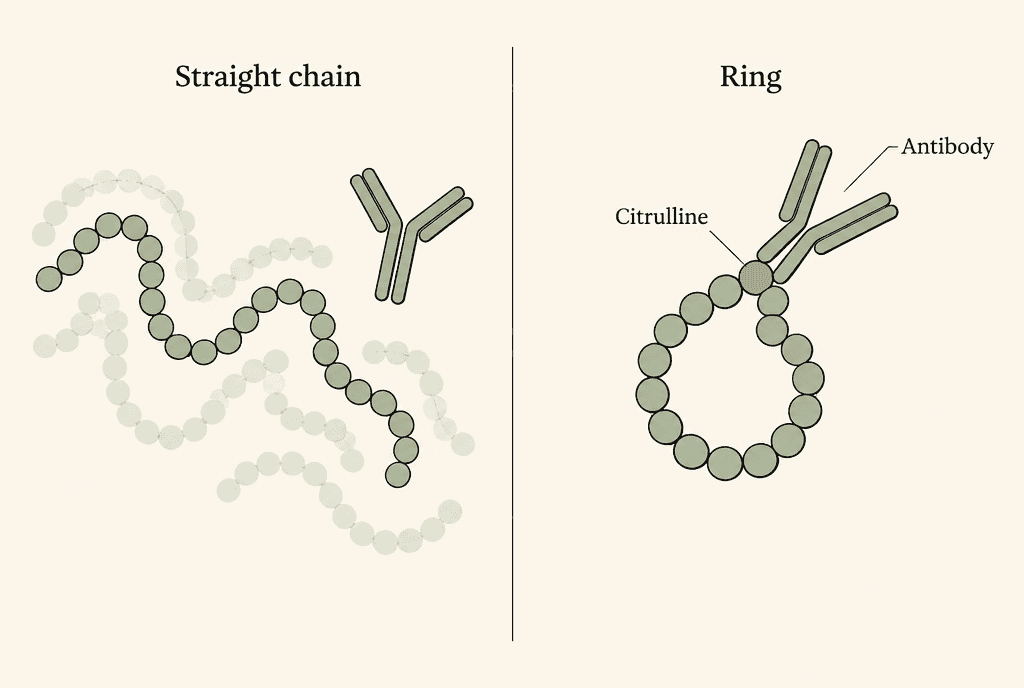
The test peptide is made into a ring because the ring holds the citrulline in a shape that antibodies recognise better. The team behind the first test reported better results with ring-shaped peptides than with straight ones. The test missed fewer real cases (higher sensitivity) and raised fewer false alarms (higher specificity). A short straight peptide has no fixed shape in liquid. It flops about like a loose piece of string. Studies of antibodies bound to peptides often show the peptide bent into a β-turn, a tight hairpin, and a ring forces a similar bend. One common way to close the ring is a bridge between two cysteines.
The ring is not a rule for every peptide. A 2016 study notes that the gain from making a ring was not found for all peptides. A study of another filaggrin peptide, positions 228 to 245, found that a ring made no difference.
In the 2016 team's own screen, small ring-shaped peptides of 10 to 12 amino acids did better than straight ones. The charged amino acids next to citrulline were also essential for antibody binding, most of all the one four places after citrulline. Shape and charge both count.
What are anti-CCP antibodies?
Anti-CCP antibodies are autoantibodies, immune proteins aimed at the body's own molecules. They bind proteins that carry citrulline. Their other name is anti-citrullinated protein antibodies, or ACPA. Rheumatoid arthritis is a long-term condition in which the immune system attacks the joints. In 1998, researchers found antibodies to lab-made citrulline-containing peptides in 76% of serum samples from people with rheumatoid arthritis. Serum is the liquid part of blood. The specificity was 96%. Specificity is the share of samples from people without the condition that test negative. The same paper showed that citrulline is an essential part of what these antibodies recognise.
The antibodies in that study also reacted with filaggrin taken from human skin. They were present early, even before other signs of the condition appeared. The authors read this as a hint that citrulline-containing epitopes, the parts of a molecule an antibody grabs, may play a role in rheumatoid arthritis. That is an idea under study, not a settled cause.
What does the anti-CCP test measure?
The anti-CCP test measures how much anti-CCP antibody a blood sample holds. Laboratories most often run it as an ELISA, short for enzyme-linked immunosorbent assay. In an ELISA, the ring-shaped peptide is fixed to a plate and serum, the liquid part of blood, is added. Antibodies that grab the peptide stay behind, and they are detected as a signal. The signal is compared with a cut-off for that test, called the upper limit of normal. The test reads one antibody, and no single antibody result describes a whole person.
Studies of the test describe groups of samples. They report sensitivity, the share of samples from people with the condition that test positive. They also report specificity, the share from people without it that test negative.
Researchers also run the test beside rheumatoid factor (RF), an older antibody marker. In the 2000 study, adding the anti-CCP ELISA to an ELISA for the IgM type of rheumatoid factor raised the positive predictive value to 91%. Positive predictive value is the share of positive results that are true positives.
How accurate was the anti-CCP test in published studies?
Published studies describe the anti-CCP test as highly specific but only moderately sensitive for rheumatoid arthritis. In plain words, in these studies it seldom flagged people without the condition, but it missed about a third of people who had it. A 2007 meta-analysis, which combines many studies into one estimate, pooled 37 studies of anti-CCP antibody. It found a sensitivity of 67% and a specificity of 95%. The same analysis pooled 50 studies of IgM rheumatoid factor and found 69% sensitivity and 85% specificity. The authors noted that many studies had weaknesses in method, so the pooled figures are estimates.
The original 2000 study gave a specificity of 98% and a sensitivity of 68% in samples from established rheumatoid arthritis. In a group from an early arthritis clinic, the specificity was 96% and the sensitivity 48%. The numbers move with the group studied, so they are not fixed properties of the test.
The 2007 authors concluded that anti-CCP antibodies are more specific than RF for rheumatoid arthritis and may better predict erosive disease, meaning damage to the bone at the joint. The table below sets the two markers side by side.
How do the 2010 ACR/EULAR criteria use anti-CCP results?
The 2010 classification rules from two rheumatology bodies, ACR and EULAR, score four areas called domains. They are joint involvement (0 to 5 points), serology, meaning blood antibody tests (0 to 3), acute-phase response, a blood sign of inflammation (0 to 1), and how long symptoms have lasted (0 to 1). A total of 6 or more out of 10 classifies definite rheumatoid arthritis. That applies when at least one joint has synovitis, swelling of the joint lining, and nothing explains it better. Anti-CCP antibody counts in the serology domain, alongside rheumatoid factor.
The serology points depend on the level measured. A negative result scores 0. A low-positive result, above the upper limit of normal but no more than three times that limit, scores 2. A high-positive result, more than three times the limit, scores 3.
The working group built the rules around patients newly showing undifferentiated inflammatory synovitis, joint-lining swelling not yet tied to a named disease. The aim was to find the features that best pick out those at high risk of lasting or erosive disease. The paper calls them classification criteria: rules that sort patients into a defined group. The same text appeared in Annals of the Rheumatic Diseases in 2010.
Comparison
Pooled figures from one 2007 meta-analysis of studies published up to September 2006. The authors flagged weaknesses in method in many included studies, and RF studies varied widely.
| Measure | Anti-CCP antibody | IgM rheumatoid factor | Source |
|---|---|---|---|
| Studies pooled | 37 | 50 | Nishimura et al., 2007 |
| Pooled sensitivity (share of people with the condition who tested positive) | 67% (95% CI 62% to 72%) | 69% (95% CI 65% to 73%) | Nishimura et al., 2007 |
| Pooled specificity (share of people without the condition who tested negative) | 95% (95% CI 94% to 97%) | 85% (95% CI 82% to 88%) | Nishimura et al., 2007 |
FAQ
How do you pronounce anti-CCP and cyclic citrullinated peptide?
Anti-CCP is said "AN-tee see-see-PEE" (some speakers say "AN-tie"). Cyclic citrullinated peptide is "SIK-lik SIT-rul-in-AY-ted PEP-tide", and citrulline is "SIT-rul-een". Capital letters mark the stressed syllable.
What does CCP stand for?
CCP stands for cyclic citrullinated peptide: a short chain of amino acids that contains citrulline and is closed into a ring.
Are anti-CCP antibodies the same as ACPA?
ACPA stands for anti-citrullinated protein antibodies. Laboratories most often detect them by how they react to cyclic citrullinated peptides in an ELISA, which is why the test carries the CCP name.
Is anti-CCP antibody the same thing as rheumatoid factor?
No. Rheumatoid factor and anti-CCP antibody are separate markers, measured by separate tests. A 2007 meta-analysis compared them side by side.
More in this hub
- Which peptides are approved in Australia and by the FDA?
- What are peptides? Meaning, medicines, safety and legal status in Australia
- What is a peptide bond? Peptide structure, chemistry and synthetic peptides explained
- Peptide vs protein: what is the difference? Peptides compared with proteins, hormones, collagen and approved medicines
- What do peptides do? What published studies found
- Peptide side effects: what studies and regulators have recorded
- Do peptides show up on drug tests? How peptides are tested and labelled
- What have collagen peptide studies measured about muscle?
- What is a signal peptide, and how does it direct a protein?
- What is carnosine, and what do studies measure?
- What is CGRP, and how does its signalling work?
- What is icotrokinra, and what do receptor studies measure?
- What is irisin, and how is it studied?
- What is lunasin, and what have studies measured?
- What is pramlintide, and how does amylin signalling work?
- What is peptide YY, and what do studies measure?
- What does TAT-DATNT refer to in peptide research?
Citations
8 sourcesAletaha D et al. Arthritis & Rheumatism. 2010;62(9):2569-2581.
doi:10.1002/art.27584Aletaha D et al. Annals of the Rheumatic Diseases. 2010;69(9):1580-1588.
doi:10.1136/ard.2010.138461Schellekens GA et al. Journal of Clinical Investigation. 1998;101(1):273-281.
doi:10.1172/JCI1316Schellekens GA et al. Arthritis & Rheumatism. 2000;43(1):155-163.
doi:10.1002/1529-0131(200001)43:1%3C155::AID-ANR20%3E3.0.CO;2-3Vossenaar ER et al. BioEssays. 2003;25(11):1106-1118.
doi:10.1002/bies.10357Ishigami A, Maruyama N. Geriatrics & Gerontology International. 2010;10(Suppl 1):S53-S58.
doi:10.1111/j.1447-0594.2010.00593.xNishimura K et al. Annals of Internal Medicine. 2007;146(11):797-808.
doi:10.7326/0003-4819-146-11-200706050-00008Trier NH et al. PLoS ONE. 2016;11(12):e0168542.
doi:10.1371/journal.pone.0168542
Continue
Research peptide reference material catalogueResearch use only — not for human or animal use.
Read the peptide science hubForm Laboratories supplies research-use-only reference material. This article is an educational summary of published third-party literature. It is not medical advice, not a use instruction, and research material is not for human or animal use.