
Hub · Peptide Science
What is peptide YY, and what do studies measure?
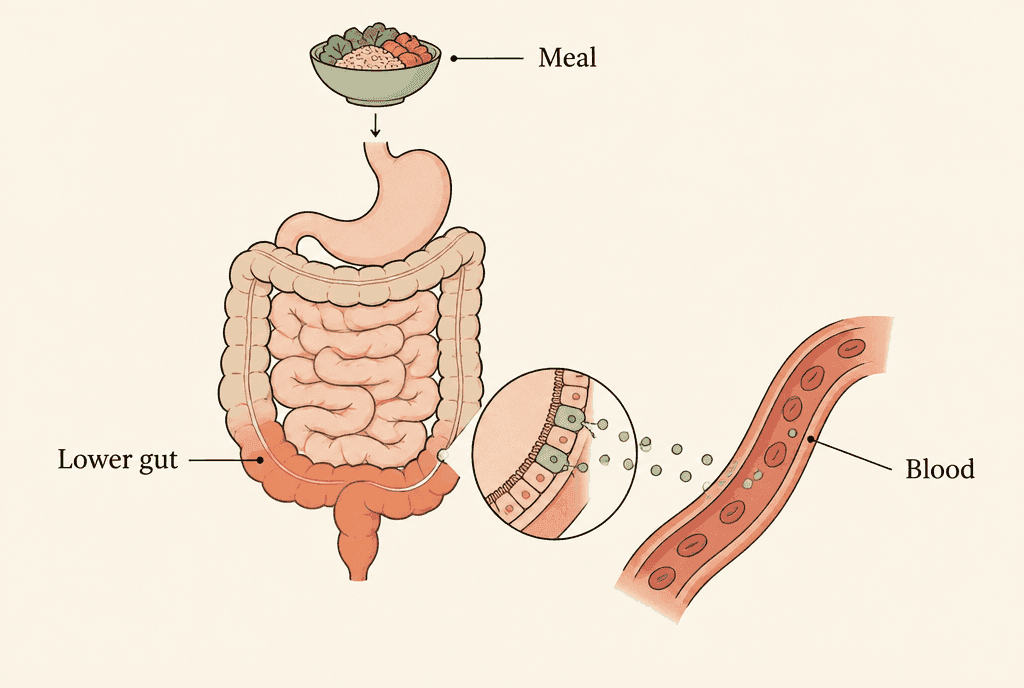
Peptide YY, or PYY, is a hormone your gut releases after food. A hormone is a chemical message carried in the blood. PYY comes in more than one form, and each form fits the cell's receivers, called receptors, in its own way. Studies measure blood levels, receptor activity, hunger, food eaten and unwanted effects. A short experiment cannot show lasting health outcomes.
01Natural gut signalContents
Halfway through lunch, the food on your plate can start to look less inviting. Meanwhile, your gut is doing two jobs at once. It moves food along, and it sends chemical messages to the rest of the body. PYY is one of those messages. Feeling full seems simple, but scientists split it into many separate questions. The peptide science hub explains how short chains of amino acids, the building blocks of proteins, carry signals like this.
You might meet PYY in three places: as a blood test result, as a molecule in a lab paper, or as a signal in an appetite study. Each one asks a different question. Once you know which one a paper is about, its findings become much easier to read.
Key facts
| Name | Peptide YY; peptide tyrosine tyrosine (Adrian et al., 1985) |
|---|---|
| Full-length form | PYY1–36: 36 amino acids (Grandt et al., 1994) |
| Shorter form | PYY3–36: positions 3–36 of the chain (Grandt et al., 1994) |
| Origin | Gut endocrine cells (Adrian et al., 1985) |
| Processing enzyme | Dipeptidyl peptidase IV, also called DPP-4 (Mentlein et al., 1993) |
| Receptor focus | Y2 for PYY3–36 (Batterham et al., 2002) |
What is PYY, and where does the body make it?
PYY is a hormone made by special cells in the gut lining. They are called endocrine cells, which means cells that release chemical messages. In 1985, Adrian and colleagues mapped PYY in human gut tissue. They found more PYY in the lower gut than in the upper small intestine. They also measured blood levels and saw them rise after meals. That supports PYY's role as a natural gut signal. But knowing where a hormone is found, and when it rises, is like knowing when a doorbell rings. It does not tell you who answers, or which changes the hormone causes elsewhere in the body.
PYY is both a hormone and a peptide. Hormone describes its job: it is a message. Peptide describes its build: it is a chain of amino acids. The introduction to peptides explains those building blocks. The name alone says little about which cells receive the message.
What do PYY1–36 and PYY3–36 mean?
PYY1–36 is the full chain of 36 amino acids. PYY3–36 is the same chain with the first two amino acids missing. The numbers work like seat numbers: they mark positions along the chain. In lab experiments, Mentlein and colleagues showed that an enzyme called DPP-4 removes those first two units. An enzyme is a protein that carries out a chemical change, and DPP-4 cuts peptides. This small cut matters. The ends of a peptide help decide which receptors it fits, so a shorter chain can carry a different signal. The form named in a paper is part of the finding, not a detail to skip.
Think of a key with its tip filed down. It is still mostly the same key, but it may now fit different locks. The peptide bond guide explains how amino acids link together. Cutting the chain changes the molecule, so a study of one form cannot simply stand in for a study of the other.
How does PYY signal through receptors?
PYY works by binding to Y receptors. A receptor is a protein on a cell that receives a signal, a bit like a lock waiting for the right key. Full-length PYY1–36 can bind both Y1 and Y2. Trimming off the first two amino acids changes that pattern. In the appetite experiments covered here, PYY3–36 acts mainly through Y2. In 2002, Batterham and colleagues compared ordinary mice with mice that had no Y2 receptor. In the mice without Y2, the food-intake response was missing. A test like this checks a proposed mechanism. But a mouse result does not show how much the same pathway matters for eating in a person.
Scientists also want to see what binding looks like up close. In 2021, Tang and colleagues mapped the shape of the Y2 receptor while it held a blocking molecule. That study shows molecular contacts. It is not a trial of PYY in people. The guide to peptide functions shows where receptor signals fit among the other jobs peptides do.
What does a PYY blood measurement show?
A PYY blood test shows how much PYY that particular test can detect in a sample. It does not show how strongly each target cell responds. In 1994, Grandt and colleagues built a test based on antibodies, proteins that latch onto one specific target. Their test picked up both main forms of PYY. The team also used chromatography, a way of separating molecules, to tell the forms apart in human blood. So a combined reading is not the same as a result for PYY3–36 alone. A clear report names the form measured, the test used, and whether the sample came from before or after a meal.
Blood tests and hunger scores are separate pieces of evidence. A change in a blood level does not establish a matching change in hunger. The gap between total PYY and one specific form also explains why two papers can both say PYY while measuring different things.
What do human PYY studies measure?
Human PYY studies measure how hungry people say they feel, how much food they eat, and markers in the blood. Each measure answers its own question. In 2003, Batterham and colleagues compared PYY3–36 with a placebo, a dummy control treatment. The study was blinded, and it was a crossover: each person took part under both conditions. The team recorded lower food intake under the PYY condition and also measured other hormones. But the study covered only a short period. It does not establish lasting weight change, disease prevention or long-term safety. A hunger score also cannot stand in for a direct measure of food eaten.
In 2007, Sloth and colleagues asked wider questions. They measured energy use, blood sugar, insulin and free fatty acids, which are fats moving through the blood. Nausea limited participation under one PYY3–36 condition. When you read a study, unwanted effects and missing results matter alongside its main result.
Evidence limits
What has PYY research not established?
The papers here do not show that a short PYY experiment predicts lasting health outcomes. They also do not show that every experimental setting gives the same result. In 2004, Tschöp and colleagues reported trouble reproducing earlier findings in rodents. Their report did not establish why the results disagreed. Human findings have limits too. A controlled meal study answers a narrower question than a long-term clinical trial. A molecular mechanism, a change in blood level and a change in food eaten are linked research topics. Still, each one needs its own evidence before anyone can draw a conclusion about it.
PYY is worth understanding as part of normal body chemistry. Research material is not a medicine and is not for human or animal use. The peptide safety evidence guide explains why observations from a small study cannot settle safety for everyone.
Comparison
The two main PYY forms, as described in the cited lab and receptor studies. The table compares molecules, not health outcomes.
| Form | Chain | Receptors it binds | Key studies |
|---|---|---|---|
| PYY1–36 | Full chain of 36 amino acids | Both Y1 and Y2 | Grandt et al., 1994; Mentlein et al., 1993 |
| PYY3–36 | Positions 3 to 36; DPP-4 removes the first two amino acids | Mainly Y2 in the appetite experiments cited | Mentlein et al., 1993; Batterham et al., 2002 |
FAQ
What does PYY stand for?
PYY stands for peptide YY. It is also called peptide tyrosine tyrosine. Adrian and colleagues used both names in their 1985 study of the human gut.
Is PYY a peptide or a hormone?
PYY is both. Peptide describes the chain of amino acids. Hormone describes its job as a chemical message released into the blood. Measurements of human gut tissue and of blood after meals support that signalling role.
Are PYY and PYY3–36 the same thing?
PYY is the broad name. PYY3–36 is a shorter form that binds receptors differently from full-length PYY1–36. A good paper names the form it tested.
Does a PYY result explain someone's hunger?
No. A PYY result alone cannot establish why one person feels hungry. The human experiments covered here measured appetite and food intake separately from blood hormone levels. A finding about a group is not a diagnosis for one person.
More in this hub
- Which peptides are approved in Australia and by the FDA?
- What are peptides? Meaning, medicines, safety and legal status in Australia
- What is a peptide bond? Peptide structure, chemistry and synthetic peptides explained
- Citrullinated peptide antibodies: what anti-CCP is, why the test peptide is cyclic and how it is pronounced
- Peptide vs protein: what is the difference? Peptides compared with proteins, hormones, collagen and approved medicines
- What do peptides do? What published studies found
- Peptide side effects: what studies and regulators have recorded
- Do peptides show up on drug tests? How peptides are tested and labelled
- What have collagen peptide studies measured about muscle?
- What is a signal peptide, and how does it direct a protein?
- What is carnosine, and what do studies measure?
- What is CGRP, and how does its signalling work?
- What is icotrokinra, and what do receptor studies measure?
- What is irisin, and how is it studied?
- What is lunasin, and what have studies measured?
- What is pramlintide, and how does amylin signalling work?
- What does TAT-DATNT refer to in peptide research?
Citations
8 sourcesAdrian TE, Ferri GL, Bacarese-Hamilton AJ, et al. Gastroenterology. 1985;89(5):1070–1077.
doi:10.1016/0016-5085(85)90211-2Mentlein R, Dahms P, Grandt D, Krüger R Regulatory Peptides. 1993;49(2):133–144.
doi:10.1016/0167-0115(93)90435-bGrandt D, Schimiczek M, Beglinger C, et al. Regulatory Peptides. 1994;51(2):151–159.
doi:10.1016/0167-0115(94)90204-6Batterham RL, Cowley MA, Small CJ, et al. Nature. 2002;418(6898):650–654.
doi:10.1038/nature00887Batterham RL, Cohen MA, Ellis SM, et al. New England Journal of Medicine. 2003;349(10):941–948.
doi:10.1056/NEJMoa030204Sloth B, Holst JJ, Flint A, et al. American Journal of Physiology–Endocrinology and Metabolism. 2007;292(4):E1062–E1068; corrected abstract.
doi:10.1152/ajpendo.00450.2006Tschöp M, Castañeda TR, Joost HG, et al. Nature. 2004;430(6996):1 page following 165; discussion follows.
doi:10.1038/nature02665Tang T, Hartig C, Chen Q, et al. Nature Communications. 2021;12:737.
doi:10.1038/s41467-021-21030-9
Form Laboratories supplies research-use-only reference material. This article is an educational summary of published third-party literature. It is not medical advice, not a use instruction, and research material is not for human or animal use.