
Hub · Peptide Science
What is carnosine, and what do studies measure?
Carnosine is a natural dipeptide: a small molecule made of two amino acids, beta-alanine and L-histidine. It is found in skeletal muscle, the muscle that moves your body. Carnosine studies measure enzyme activity, chemical reaction products and how much carnosine is in a tissue. Each measurement answers a different question. None of them, on its own, establishes a health outcome.
01What carnosine isContents
Picture a sprinter in the last few metres of a race, legs straining. Deep in those busy muscle fibres, tiny molecules take part in chemistry that is easy to miss when a discussion starts with product names. Carnosine belongs to that quieter story.
The wider science of peptides puts carnosine in its biological setting. This page follows the molecule from its building blocks to the measurements in published papers. The useful question is simple: what did each experiment actually measure?
Key facts
| Name | Carnosine |
|---|---|
| Chemical name | Beta-alanyl-L-histidine (Drozak et al., 2010) |
| Class | Dipeptide (Drozak et al., 2010) |
| Parts | Beta-alanine and L-histidine (Drozak et al., 2010) |
| Formation enzyme | Carnosine synthase (Drozak et al., 2010) |
| Breakdown enzyme | Carnosinase CN1 (Teufel et al., 2003) |
| Human tissue measured | Calf muscle (Ozdemir et al., 2007) |
Is carnosine a peptide?
Yes. Carnosine is a dipeptide, which means two amino acids linked together. Its two parts are beta-alanine and L-histidine, as Drozak and colleagues described in 2010. That makes carnosine a small molecule, not a long protein chain. Picture a bracelet with two beads next to a long necklace. The name tells you the structure. It does not tell you what happens when scientists study the molecule in a person. A chemical identity, a job inside a cell and a measured health outcome are three different kinds of knowledge. Each one needs evidence that matches the question being asked.
Carnosine is a useful example for the explanation of what peptides are. Being short does not make every peptide a hormone, or give every peptide the same job. The peptide bond page explains the link between amino acids; which parts are linked matters as much as the link.
How does the body make and break down carnosine?
An enzyme called carnosine synthase joins beta-alanine to L-histidine. Another enzyme, carnosinase, can split carnosine apart. Enzymes are proteins that carry out chemical changes. Drozak and colleagues identified the joining enzyme using chicken muscle and tests of mouse and human proteins made in cultured cells. Teufel and colleagues studied purified human carnosinase and measured which small peptides it split. These were enzyme experiments, not tests of a health outcome. They explain how carnosine is built and broken down under the tested conditions. Enzyme activity alone does not show how much carnosine reaches a particular human tissue.
Carnosine levels work a bit like a bath with the tap running and the plug out: formation adds molecules, while breakdown removes them. A tissue measurement captures the amount present at one chosen moment. That amount does not reveal every process behind the reading. The diagram shows the formation step only, not a full map of how the body handles carnosine.
What chemical roles do carnosine studies examine?
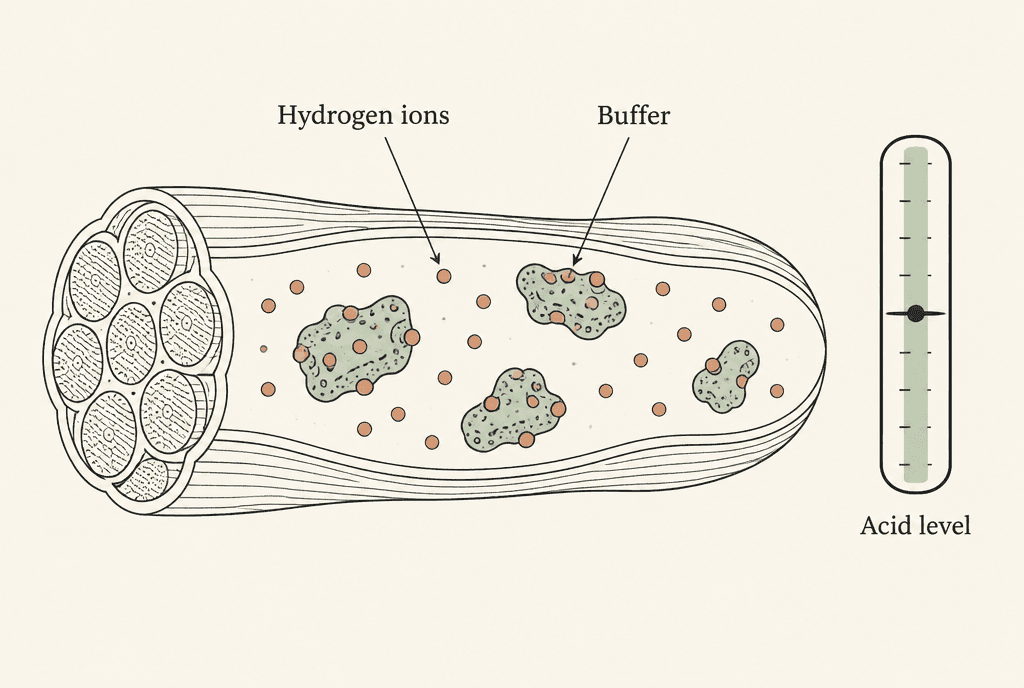
Carnosine research looks at two chemical jobs. The first is acid buffering. A buffer takes up or releases hydrogen ions as acidity changes, a bit like a sponge that soaks up spills. Ozdemir and colleagues discuss this proposed role in muscle. The second job is reacting with molecules formed when fats undergo oxidation, a chemical change in which electrons are lost. Aldini and colleagues measured carnosine reaction products in solutions and in broken-up rat muscle tissue. Those products show that a reaction happened in the tested samples. They do not establish a health effect in people, or how important that reaction is inside living human muscle.
The Aldini study tracked HNE, a reactive molecule called an aldehyde that can form when fats oxidise. The researchers used instruments to identify adducts, which are new molecules formed when two chemical partners join. A named reaction product is more precise than a broad claim about protection. How mass spectrometry checks identity explains the method behind that kind of evidence.
How do researchers measure carnosine in human muscle?
Researchers can measure muscle carnosine from a tissue sample. They can also estimate it with magnetic resonance spectroscopy, a scan that detects chemical signals. In 2007, Ozdemir and colleagues tested this scan in the calf muscles of athletes and untrained volunteers. They also used reference samples to check the method. The study measured carnosine concentration, meaning the amount in a given volume. That was the endpoint: the result the researchers set out to measure. The study did not show that a higher reading causes better performance. It also did not show that changing the reading produces a health outcome.
Carnosine concentration measures tissue chemistry. A task result, such as how long a muscle can keep working, asks a different question. A difference between groups can prompt another study, but a group difference alone does not explain its cause. The same care applies when reading how peptides and proteins differ: a molecule's size says little about which endpoint will be useful.
Evidence limits
What do carnosine measurements establish, and what remains uncertain?
A carnosine measurement establishes the result recorded in one particular model; a chemical finding alone cannot establish a clinical outcome. The papers here examine enzyme function, reaction products and human muscle concentration. They do not settle how much each proposed chemical role contributes to normal human body chemistry. A lab reaction can be real while its importance in a living person stays uncertain. A sound human tissue measurement can also leave cause and effect unexplained. These are limits of the questions these studies tested. They are not a claim that no other carnosine research exists.
An endpoint gives a paper a clear finish line. Evidence is easier to judge when the endpoint, the study setting and the conclusion stay together. The overview of what peptides do places different biological roles in context. Neither a shared peptide label nor a familiar chemical term makes findings interchangeable between molecules.
Comparison
Where each selected carnosine study was done and what it measured. The rows compare research questions; they do not rank outcomes.
| Study setting | What was measured | What it cannot show |
|---|---|---|
| Purified enzymes | How carnosine is formed or broken down (Drozak et al., 2010; Teufel et al., 2003) | A whole person's response |
| Solutions and rat tissue preparations | Chemical reaction products (Aldini et al., 2002) | That the same process happens in living human tissue |
| Human calf muscle | Carnosine concentration (Ozdemir et al., 2007) | What causes a performance difference |
FAQ
Is carnosine an amino acid or a peptide?
Carnosine is a peptide made from linked amino acids, not a single amino acid. Drozak and colleagues identify its parts as beta-alanine and L-histidine. The word dipeptide describes that two-part structure.
Is carnosine the same as beta-alanine?
No. Beta-alanine is a building block of carnosine, not the finished molecule. In the enzyme work reported by Drozak and colleagues, carnosine synthase joins beta-alanine with L-histidine. Findings about a building block should not be relabelled as findings about carnosine.
What is carnosinase?
Carnosinase is an enzyme that breaks down carnosine. Teufel and colleagues identified human CN1 as carnosinase by testing the purified protein against different small peptides. An enzyme test describes chemical activity under the tested conditions.
Does a muscle carnosine reading measure strength?
No. A carnosine reading measures a chemical signal or concentration, not strength. The human calf study by Ozdemir and colleagues tested a way to measure tissue carnosine. Strength needs its own test, and the concentration reading cannot stand in for that result.
More in this hub
- Which peptides are approved in Australia and by the FDA?
- What are peptides? Meaning, medicines, safety and legal status in Australia
- What is a peptide bond? Peptide structure, chemistry and synthetic peptides explained
- Citrullinated peptide antibodies: what anti-CCP is, why the test peptide is cyclic and how it is pronounced
- Peptide vs protein: what is the difference? Peptides compared with proteins, hormones, collagen and approved medicines
- What do peptides do? What published studies found
- Peptide side effects: what studies and regulators have recorded
- Do peptides show up on drug tests? How peptides are tested and labelled
- What have collagen peptide studies measured about muscle?
- What is a signal peptide, and how does it direct a protein?
- What is CGRP, and how does its signalling work?
- What is icotrokinra, and what do receptor studies measure?
- What is irisin, and how is it studied?
- What is lunasin, and what have studies measured?
- What is pramlintide, and how does amylin signalling work?
- What is peptide YY, and what do studies measure?
- What does TAT-DATNT refer to in peptide research?
Citations
4 sourcesDrozak J, Veiga-da-Cunha M, Vertommen D, et al. Journal of Biological Chemistry. 2010;285(13):9346-9356.
doi:10.1074/jbc.M109.095505Teufel M, Saudek V, Ledig JP, et al. Journal of Biological Chemistry. 2003;278(8):6521-6531.
doi:10.1074/jbc.M209764200Aldini G, Granata P, Carini M Journal of Mass Spectrometry. 2002;37(12):1219-1228.
doi:10.1002/jms.381Ozdemir MS, Reyngoudt H, De Deene Y, et al. Physics in Medicine and Biology. 2007;52(23):6781-6794.
doi:10.1088/0031-9155/52/23/001
Form Laboratories supplies research-use-only reference material. This article is an educational summary of published third-party literature. It is not medical advice, not a use instruction, and research material is not for human or animal use.