
Hub · Peptide Science
What is lunasin, and what have studies measured?
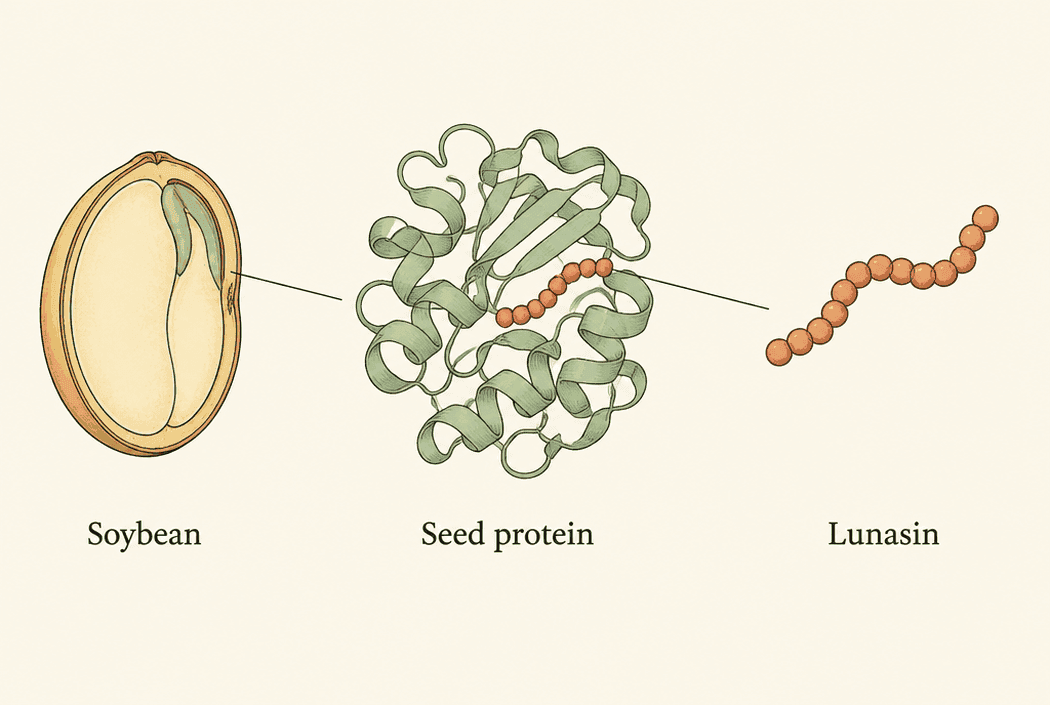
Lunasin is a short chain of amino acids found inside a soybean seed protein. Studies have measured lunasin's chemical form, its behaviour in lab cells, and its presence in human blood. One human trial tested a soy extract rich in lunasin. That trial found no significant changes in the health markers it measured.
01IdentityContents
Your stomach meets soy as a food. A laboratory, by contrast, can study one tiny piece of soy protein. That jump in scale matters. Lunasin raises a useful question: what can a study of a single soy peptide really show? The answer depends on whether scientists looked at a molecule, cells in a dish or people. This page belongs to the peptide science hub.
You may meet the same name in a chemistry paper and in a headline about food. Looking at what the researchers measured shows you where those stories connect, and where the evidence stops.
Key facts
| Name | Lunasin |
|---|---|
| Origin | Soybean seed 2S albumin protein (Seber et al., 2012) |
| Earlier sequence description | 43 amino acids (Dia et al., 2009) |
| Predominant form in analysed soy flour | 44 amino acids (Seber et al., 2012) |
| Early cell paper | Galvez and de Lumen, Nature Biotechnology, 1999 |
| Human blood study | Five healthy men (Dia et al., 2009) |
| Human extract trial | 31 participants; placebo comparison (Haddad Tabrizi et al., 2020) |
What is the lunasin peptide?
Lunasin is a peptide found inside soybean 2S albumin, a protein stored in the seed. It is not a hormone made by the human body. A peptide is a chain of amino acids, the small units that build proteins. Earlier work described lunasin as a chain of 43 amino acids. A 2012 study of soy flour found that the main form had 44. The extra unit was asparagine, at the end of the chain. So the name lunasin alone leaves a useful question open. Which form was actually in the material being studied?
Peptide names describe molecules, not health outcomes. The meaning of peptide and the bonds joining amino acids explain the basic terms. The difference between a peptide and a protein is about structure. Neither label shows what happens in people.
What did early lunasin cell experiments measure?
Early lunasin experiments measured cell division and where material ended up inside lab cells. They did not measure outcomes in patients. In 1999, researchers built a gene that made lunasin joined to a green glowing marker. They used it in mouse and human cell lines. A cell line is a group of cells kept growing in a lab. The researchers reported that cell division was disrupted. They also looked at binding to chromatin, the package of DNA and proteins inside a cell. These findings describe that engineered experiment. They do not show that food or a finished product causes the same events.
The glowing marker made the linked material easy to track. But making a peptide inside a cell is a different experiment from checking what reaches a tissue from outside. The setting of an experiment belongs next to its result, even after a paper becomes a headline.
Why do lunasin papers discuss histones?
Lunasin papers discuss histones because researchers measured how lunasin interacts with them. Histones are proteins that help package DNA, a bit like spools that thread winds around. Histone acetylation means adding small chemical tags to histones. These tags are part of how cells control access to genes. A 2011 study compared human prostate cell lines that differ in how they form tumours. The researchers measured gene activity and histone tags. The cell types responded differently. Sharing a human origin did not make the cells respond alike. These experiments explore a possible mechanism, meaning a proposed explanation of events inside cells.
The histone study looked at THBS1, among other genes. THBS1 carries the instructions for a protein called thrombospondin. The difference between the cell types matters: a molecular finding depends on its setting. A mechanism can guide later research without showing a health outcome in a person.
Has lunasin been detected in human blood?
Material linked to lunasin has been found in human blood after people consumed soy protein. But finding it is not evidence of a health effect. A 2009 study looked at five healthy men and tested their plasma, the liquid part of blood. Antibody-based tests picked up a signal attributed to lunasin. Mass spectrometry identified pieces of the lunasin sequence. This method sorts molecules by their mass and electric charge. The study asked whether material from the soy peptide could be found in blood. It did not measure whether any disease was prevented or treated.
Different tests answer different questions. An antibody signal and a matching molecular piece are different kinds of evidence. How mass spectrometry checks peptide identity explains why the test method matters when a report says a peptide was found.
What did the human lunasin-enriched soy extract trial measure?
The human trial measured blood fats, blood sugar, insulin-related measures, blood pressure and body measurements. It found no significant changes with the tested extract. The 2020 trial had 31 participants. It was blinded, a design that hides which product was given. It was also placebo-controlled. A placebo is a comparison product without the tested ingredient. And it was a crossover trial: each person had both products, at different times. Each period lasted eight weeks. The product was a soy extract rich in lunasin, not pure lunasin. So the trial cannot separate lunasin's own contribution from the rest of the extract.
A result without statistical significance leaves uncertainty. It does not show a useful effect, and one small study cannot settle every question. The result applies to the tested material, the participants and the measured outcomes. Going beyond those limits needs further evidence.
Why do lunasin studies need separate explanations?
Lunasin studies need separate explanations because each kind asks a different question. A chemical analysis shows what a sample contains. A cell experiment explores a possible interaction. A blood test checks whether related material is present. A human comparison tests a stated outcome under study conditions. Putting these findings into one story only helps if the gaps between them stay visible. No one type of study can replace another. Think of four separate exam papers: a pass on one paper does not mark the other three. A finding at an early stage does not fill in a missing result later.
The diagram groups the research by question. The groups are not a promise that each finding leads to a clinical effect. Reading across them shows the gaps that any broad claim about lunasin would still need to fill.
Evidence limits
What has lunasin research not established?
The lunasin papers on this page do not show a health outcome from purified lunasin in people. A soy extract contains more than the named peptide. A signal in blood does not show what happens in a target tissue. The cell studies explore biology without measuring patient outcomes. The unproven step is the bridge between these findings: the idea that the same molecule, in a different setting, gives a useful result in humans. These sources do not build that bridge. So this page reports each finding together with the material and study setting behind it.
This boundary applies to the papers cited here. This page does not claim to list every lunasin study or every possible outcome. Questions about lasting human effects, and about the role of purified lunasin on its own, remain open in this set of sources.
Comparison
The five lunasin studies named on this page, grouped by what each one measured. Cells restate published findings only. Not a guide to use.
| What was studied | What was measured | What it does not show | |
|---|---|---|---|
| Chemical analysis, 2012 | Soy flour | Main lunasin form: 44 amino acids | Any effect in people |
| Engineered cells, 1999 | Mouse and human cell lines making lunasin with a glowing marker | Cell division and binding to chromatin | That food causes the same events |
| Prostate cells, 2011 | Human prostate cell lines | Gene activity and histone tags | Patient outcomes |
| Blood detection, 2009 | Plasma from five healthy men after soy protein | Lunasin signal and lunasin sequence pieces | Prevention or treatment of disease |
| Extract trial, 2020 | 31 participants, lunasin-enriched soy extract or placebo | Blood fats, blood sugar, insulin-related measures, blood pressure, body measurements: no significant changes | The effect of purified lunasin alone |
FAQ
Is lunasin a peptide or a protein?
Lunasin is described as a peptide inside a larger soybean seed protein. A 2012 study found a main form of 44 amino acids in soy flour, compared with the earlier description of 43. Which form was studied matters when comparing papers.
Does finding lunasin in blood prove a health effect?
No. The human plasma study looked for lunasin-related material after people consumed soy protein. It did not measure disease outcomes.
Are human cell studies the same as human trials?
No. Human cell studies look at cells kept in a laboratory. Human trials look at participants. The prostate cell study measured gene activity and histone tags, not patient outcomes.
More in this hub
- Which peptides are approved in Australia and by the FDA?
- What are peptides? Meaning, medicines, safety and legal status in Australia
- What is a peptide bond? Peptide structure, chemistry and synthetic peptides explained
- Citrullinated peptide antibodies: what anti-CCP is, why the test peptide is cyclic and how it is pronounced
- Peptide vs protein: what is the difference? Peptides compared with proteins, hormones, collagen and approved medicines
- What do peptides do? What published studies found
- Peptide side effects: what studies and regulators have recorded
- Do peptides show up on drug tests? How peptides are tested and labelled
- What have collagen peptide studies measured about muscle?
- What is a signal peptide, and how does it direct a protein?
- What is carnosine, and what do studies measure?
- What is CGRP, and how does its signalling work?
- What is icotrokinra, and what do receptor studies measure?
- What is irisin, and how is it studied?
- What is pramlintide, and how does amylin signalling work?
- What is peptide YY, and what do studies measure?
- What does TAT-DATNT refer to in peptide research?
Citations
5 sourcesGalvez AF, de Lumen BO Nature Biotechnology. 1999;17(5):495-500.
doi:10.1038/8676Seber LE, Barnett BW, McConnell EJ, et al. PLOS ONE. 2012;7(4):e35409.
doi:10.1371/journal.pone.0035409Galvez AF, Huang L, et al. Nutrition and Cancer. 2011;63(4):623-636.
doi:10.1080/01635581.2011.539312Dia VP, Torres S, de Lumen BO, et al. Journal of Agricultural and Food Chemistry. 2009;57(4):1260-1266.
doi:10.1021/jf803303kHaddad Tabrizi S, Haddad E, Rajaram S, et al. Journal of Dietary Supplements. 2020;17(3):286-299.
doi:10.1080/19390211.2019.1577937
Form Laboratories supplies research-use-only reference material. This article is an educational summary of published third-party literature. It is not medical advice, not a use instruction, and research material is not for human or animal use.