
Hub · Peptide Science
What have collagen peptide studies measured about muscle?
Collagen peptide studies have measured several different things: muscle protein synthesis, meaning how fast muscle makes new protein, plus body make-up, strength and balance. These measures do not show the same thing. Controlled studies have also tested amino acids in the blood and protein building in the connective tissue around muscle. Neither of those two measures on its own proves lasting muscle growth.
01What the tests measureContents
Lift a heavy shopping bag and two things happen at once. Your muscle fibres pull, and the tough tissue wrapped around them carries the load. A blood test, a body scan and a strength test each see a different slice of that work. So the single word muscle can hide several separate research questions.
This page in the peptide science hub walks through the tests behind the headlines. You will see what each test records, where the results differ, and why a change on a body scan does not answer every question about muscle.
Key facts
| Material studied | Collagen peptides: fragments of collagen protein |
|---|---|
| Evidence setting | Controlled human studies |
| Short-term tissue measures | Muscle and connective tissue protein synthesis |
| Whole-body measures | Fat-free mass, fat mass, strength and balance |
| Older women in the synthesis study | 22 participants (Oikawa et al., 2020) |
| Older men completing the training trial | 53 participants (Zdzieblik et al., 2015) |
What do collagen peptide muscle studies actually measure?
Collagen peptide muscle studies measure different parts of muscle biology, not one single result called muscle growth. Protein synthesis is how fast a tissue makes new protein. A body scan estimates how much of each kind of tissue there is. A strength test records force. Zdzieblik and colleagues' 2015 paper measured body make-up, leg strength and balance. Aussieker and colleagues' 2023 study measured blood amino acids, the building blocks of protein, and protein building in tissue. Each test answers its own question. A result from one test cannot stand in for all the others.
Collagen peptides are small pieces made by breaking down collagen, a protein that gives tissues their structure. The name describes the material, not a proven muscle result. The peptide and protein comparison explains the difference. Research on dietary protein covers many protein sources. So a finding about protein in general is not automatically a finding about collagen peptides.
What did the collagen and whey study in older women measure?
The study measured how fast muscle made new protein over a short window and a longer window. It did not track lasting changes in strength. Oikawa and colleagues studied 22 healthy older women over six days, in a 2020 paper. Whey, a milk protein, was the other protein tested. The team used labelled tracers, tagged substances that show where new protein is made, in both a rested leg and an exercised leg. Over the longer window, muscle protein synthesis in the collagen group was not significantly above the starting level. These results apply to the women tested and the study conditions.
The study kept the two protein sources apart instead of treating every protein as the same material. The introduction to peptides explains how amino acid chains fit into the bigger protein picture. A short tissue test also leaves open questions about lasting muscle size and everyday movement.
Have collagen studies measured the connective tissue inside muscle?
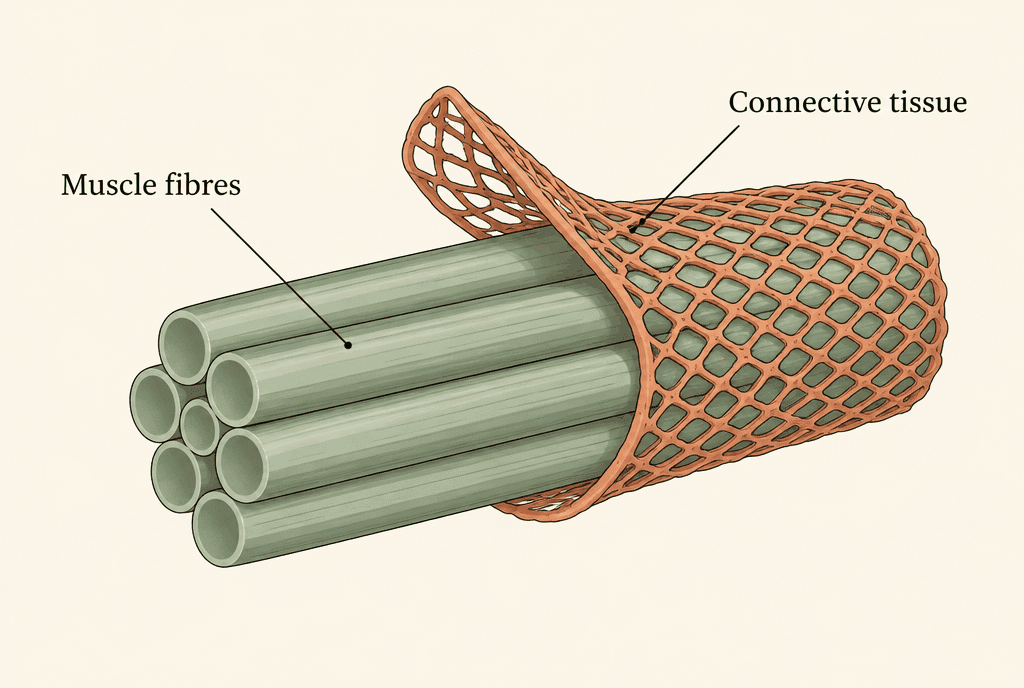
Yes. Collagen studies have measured protein building in muscle connective tissue separately from the proteins that make muscle pull. Connective tissue is the supporting mesh around muscle fibres. Aussieker and colleagues studied 45 young recreational athletes for five hours after exercise, in a 2023 paper. The trial compared collagen protein, whey protein and a placebo, a comparison with no protein. Neither protein group showed a statistically clear difference from placebo in connective tissue protein building. The collagen group also showed no clear difference from placebo in myofibrillar synthesis, the building of the proteins that make muscle contract.
The same study also measured amino acids in the blood. More building blocks in the blood did not mean faster protein building in every tissue tested. The peptide bond explainer describes the links that join amino acids into chains.
What did researchers measure across a week of training?
Researchers measured protein building across a whole training week, a longer window than one exercise session. Kirmse and colleagues studied 25 young men for one week, in a 2024 paper. Blood and muscle samples tracked amino acids and new protein during resistance exercise, meaning exercise in which muscles work against a load. Collagen peptides did not produce higher protein building rates than placebo. That held both for the proteins that make force and for the connective proteins. The trial describes tissue turnover during that week. Lasting strength, injury recovery and muscle growth each need their own measurements.
What did the older men's collagen training trial measure?
The trial measured body make-up, leg strength and balance. It did not directly track new muscle protein. Zdzieblik and colleagues reported on 53 older men who finished the 12-week study, in a 2015 paper. All had sarcopenia, the loss of muscle mass and function that comes with age. Both groups did resistance training. The authors reported differences between the collagen and placebo groups in fat-free mass, fat mass and leg strength. Fat-free mass includes tissues other than working muscle. The placebo had no protein, so the trial could not show whether collagen differed from another dietary protein.
A later correction matters when reading these results. In 2025 the authors disclosed that Gelita supplied the study samples and paid for participant compensation and sample analysis. The correction also named an author's interest as a co-inventor on a patent, with no related royalties reported. These details add context. They do not on their own decide whether a result is reliable.
Evidence limits
What do these collagen peptide studies leave unestablished about muscle?
The studies on this page do not establish one result for every age, protein source or muscle outcome. A short protein-building test cannot by itself show a lasting change in muscle size. A body scan cannot pick out the proteins that make muscle contract. Training trials mix exercise with a diet comparison, so the comparison group matters. Skin hydration findings cannot show a change in muscle, because the tissue and the outcome are different. Each paper answers a narrow question about one group and one set of tests. This record does not establish a general claim about what collagen does for everyone's muscles.
The wider guide to what peptides do in the body explains why a shared label does not mean a shared biological role. Collagen fragments, dietary proteins and the body's own signalling peptides share related chemistry. Evidence about one still cannot simply be applied to another.
Comparison
The four human studies on this page, compared by who took part, how long each ran, what it measured and what it reported.
| Study | Who took part | How long | What it measured | What it reported |
|---|---|---|---|---|
| Oikawa et al., 2020 | 22 healthy older women | Six days | Muscle protein synthesis with collagen or whey, in rested and exercised legs | Over the longer window, synthesis in the collagen group was not significantly above the starting level |
| Aussieker et al., 2023 | 45 young recreational athletes | Five hours after exercise | Blood amino acids and protein building in muscle and connective tissue; collagen, whey or placebo | Neither protein group was clearly different from placebo in connective tissue protein building; collagen was not clearly different in myofibrillar synthesis |
| Kirmse et al., 2024 | 25 young men | One week of resistance exercise | Blood amino acids and new protein in force-making and connective proteins | Collagen peptides did not produce higher protein building rates than placebo |
| Zdzieblik et al., 2015 | 53 older men with sarcopenia who finished | 12 weeks of resistance training | Fat-free mass, fat mass, leg strength and balance; collagen or a placebo with no protein | Differences from placebo in fat-free mass, fat mass and leg strength |
FAQ
Do collagen peptide muscle studies all measure muscle growth?
No. Some collagen studies measure new protein building in muscle samples. Others use body scans, strength tests or blood tests. Those outcomes answer different questions, so they cannot all be called direct measures of muscle growth.
Are collagen peptides and whey the same protein?
No. Collagen peptides are fragments of collagen, while whey is a milk protein. Oikawa and colleagues compared them as two separate protein sources in older women. They did not assume that every dietary protein gets the same response from tissue.
Does a rise in blood amino acids prove more muscle was built?
No. Blood amino acids show that building blocks are present. Tissue tests ask whether those blocks end up in new proteins. Kirmse and colleagues reported changes in blood amino acids without higher muscle protein synthesis rates than placebo.
Can collagen skin hydration findings answer muscle questions?
No. Skin hydration measures water in the skin. Muscle studies measure tissue protein building, body make-up or physical function. A study must measure the muscle outcome in question to give direct evidence about it.
More in this hub
- Which peptides are approved in Australia and by the FDA?
- What are peptides? Meaning, medicines, safety and legal status in Australia
- What is a peptide bond? Peptide structure, chemistry and synthetic peptides explained
- Citrullinated peptide antibodies: what anti-CCP is, why the test peptide is cyclic and how it is pronounced
- Peptide vs protein: what is the difference? Peptides compared with proteins, hormones, collagen and approved medicines
- What do peptides do? What published studies found
- Peptide side effects: what studies and regulators have recorded
- Do peptides show up on drug tests? How peptides are tested and labelled
- What is a signal peptide, and how does it direct a protein?
- What is carnosine, and what do studies measure?
- What is CGRP, and how does its signalling work?
- What is icotrokinra, and what do receptor studies measure?
- What is irisin, and how is it studied?
- What is lunasin, and what have studies measured?
- What is pramlintide, and how does amylin signalling work?
- What is peptide YY, and what do studies measure?
- What does TAT-DATNT refer to in peptide research?
Citations
5 sourcesOikawa SY, Kamal MJ, Webb EK, et al. The American Journal of Clinical Nutrition. 2020;111(3). Collagen and whey comparison in older women..
doi:10.1093/ajcn/nqz332Aussieker T, Hilkens L, Holwerda AM, et al. Medicine & Science in Sports & Exercise. 2023;55(10). Muscle and connective protein synthesis after exercise..
doi:10.1249/MSS.0000000000003214Kirmse M, Lottmann TM, Volk NR, et al. Medicine & Science in Sports & Exercise. 2024;56(12). Collagen peptides and tissue synthesis during training..
doi:10.1249/MSS.0000000000003519Zdzieblik D, Oesser S, Baumstark MW, et al. British Journal of Nutrition. 2015;114(8):1237–1245. Body composition and strength in older men..
doi:10.1017/S0007114515002810Zdzieblik D, Oesser S, Baumstark MW, et al. British Journal of Nutrition. 2025;134(5):440. Correction to support and conflict disclosures..
doi:10.1017/S000711452510425X
Form Laboratories supplies research-use-only reference material. This article is an educational summary of published third-party literature. It is not medical advice, not a use instruction, and research material is not for human or animal use.