
Hub · Peptide Science
What is pramlintide, and how does amylin signalling work?
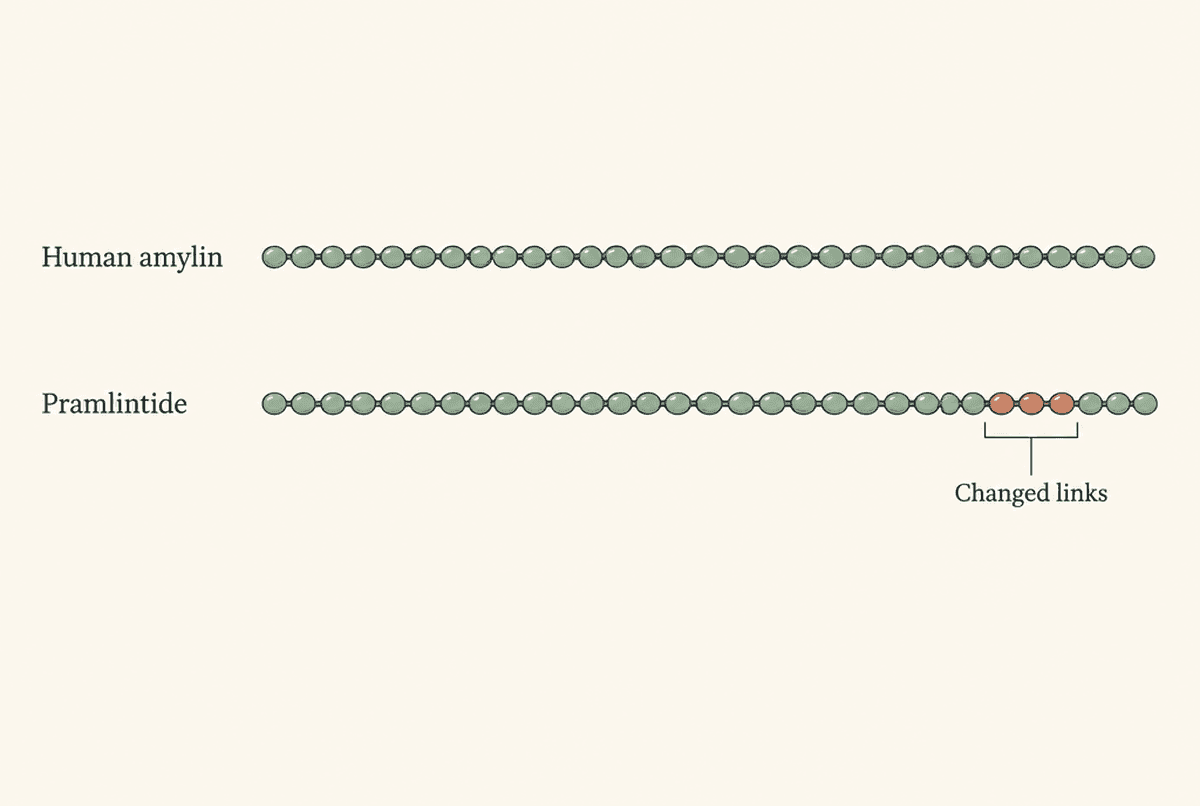
Pramlintide is a modified version of amylin, a peptide hormone the pancreas releases along with insulin after a meal. Pramlintide differs from human amylin at three spots in its chain. Studies of pramlintide measure separate things: how it switches on receptors in cells, how fast food leaves the stomach, and how meal hormones change. Each kind of study answers its own question.
01Peptide identityContents
Feeling full is not only about a stretched stomach. Your pancreas joins in too. As food arrives, it sends out chemical messages, and amylin is one of them. Here we follow that message one step at a time: the shape of the molecule, the receiver it fits, and what researchers can actually measure. It is part of peptide science.
Key facts
| Compound | Pramlintide |
|---|---|
| Class | Amylin analogue |
| Structural changes | Proline at positions 25, 28 and 29 (da Silva et al., 2016) |
| Natural signal | Amylin, also called islet amyloid polypeptide |
| Receptor components | Calcitonin receptor with a receptor activity-modifying protein |
| Evidence covered | Cell experiments, peptide chemistry and human meal studies |
What is the pramlintide peptide?
Pramlintide is an amylin analogue. An analogue is a related molecule with a few deliberate changes. Natural amylin is made by beta cells in the pancreas, the same cells that make insulin. Amylin is a peptide: a chain of amino acids, the small building blocks of proteins. Pramlintide swaps in proline, one type of amino acid, at positions 25, 28 and 29 of the human amylin chain. Those swaps affect how the peptide dissolves and how it forms clumps. But looking alike is not the same as acting alike. A changed molecule still needs testing in cells, in the stomach and in whole people.
Peptides are chains of amino acids. What are peptides? explains that basic idea. The peptide bond guide explains the links that hold the chain together.
How does an amylin receptor receive a signal?
An amylin receptor is built from two parts. The first is the calcitonin receptor, a protein on the cell surface. The second is a partner protein called a receptor activity-modifying protein, or RAMP for short. The partner changes which chemical messages the receptor recognises. In cultured cells, which are cells grown in a lab, adding RAMP partners changed how amylin attached to the receptor. Attaching is called binding. Binding alone does not prove that a signal travels into the cell. So researchers keep binding tests and response tests apart. A response test measures what happens after the receptor switches on.
The receptor is less like a lock that takes one key and more like a radio receiver with a fitted part. Change the part and the receiver picks up a different station. The partner protein matters when reading any experiment.
What do cell studies measure after pramlintide activates a receptor?
Cell studies can measure cAMP after pramlintide switches on a receptor. cAMP is a small chemical messenger inside cells. It passes the signal along, like a runner in a relay race. A 2014 study compared pramlintide with human and rat amylin. The researchers used cells carrying different receptor forms. Pramlintide switched on the tested amylin receptors and the calcitonin receptor. That shows a response in those lab cells. It does not show which receptor matters most when a person eats a meal. A dish of cells has no blood flow, no nerves, no digestion and no other hormones.
A receptor result answers a narrow question well. The peptide and protein comparison adds context on the different kinds of molecules involved in such signals.
What does stomach emptying tell researchers about amylin signalling?
Stomach emptying measures how fast food leaves the stomach. It says nothing direct about how strongly a peptide attaches to a receptor. In a 2000 human study, food left the stomach more slowly with pramlintide than with placebo. A placebo is a dummy treatment with no active compound. The same study found no significant change in how fast food moved through the small bowel or the colon. That movement through the gut is called transit. So the finding is about particular parts of the gut, under the study's conditions. Slower stomach emptying and slower movement through the whole gut are different claims.
Each claim needs its own measurement. A stomach measurement is not a direct measure of feeling full. And a cell signal cannot reveal how fast a meal moves.
What do human studies measure about pramlintide and glucagon?
Human pramlintide studies can track glucagon. Glucagon is a hormone from the pancreas that tells the liver to release glucose, the sugar in blood. A 2018 study looked at meal responses in eight people with type 1 diabetes. After pramlintide, glucagon rose less after a meal. The study compared each person's responses before and after treatment, in a small group. The study also had a separate liraglutide group. The authors said their design did not allow a formal comparison with that group. The result does not show that every group of people would respond the same way.
A hormone curve shows change over time. A lower early peak can mean something different from a change in the total response. So the exact thing measured matters.
Evidence limits
What do pramlintide studies leave uncertain about research material?
Pramlintide studies do not show that an unnamed research material matches a medicine. Identity, purity and behaviour each need their own tests. A compound name on a label is not a test of that sample. Even the chemistry has open questions. In laboratory conditions, pramlintide formed amyloid fibres, which are neat, ordered clumps of peptide. That does not show the same process happens in a person. Research material is not a substitute for a medicine and is not for human use. Testing a sample's chemistry and testing effects in people answer different questions.
The quality and verification hub explains what lab records about a sample can show. A sample record cannot turn a receptor experiment into evidence of human safety.
Comparison
The five studies named on this page, grouped by what each one measured. Cells restate published findings only. Not a guide to use.
| What was studied | What was measured | What it does not show | |
|---|---|---|---|
| Peptide chemistry, 2016 | Pramlintide in laboratory conditions | Formation of amyloid fibres | That fibres form in a person |
| Receptor binding, 1999 | Cultured cells with and without RAMP partners | How amylin attached to the receptor | That a signal travelled into the cell |
| Cell signal, 2014 | Cells carrying different receptor forms | cAMP response to pramlintide, human amylin and rat amylin | Which receptor matters most after a meal |
| Stomach emptying, 2000 | People given pramlintide or placebo | Stomach emptying, plus small-bowel and colonic transit | A direct measure of feeling full |
| Meal hormones, 2018 | Eight people with type 1 diabetes | Rise in glucagon after a meal | The same response in every population |
FAQ
Is pramlintide the same as amylin?
No. Pramlintide is a modified version of human amylin, with proline swapped in at three spots in the chain. The two names describe related molecules, not an identical sequence.
Is an amylin receptor the same as an insulin receptor?
No. An amylin receptor is made of the calcitonin receptor plus a RAMP partner. That is a different receptor from the one insulin uses. Being released at the same time as insulin does not mean amylin shares insulin's receptor.
Does a cell response prove what happens after a meal?
No. A cell response shows activity in the tested cells. Meal studies measure a different level of biology, such as stomach emptying or hormone changes in blood. Neither measurement alone explains every part of amylin signalling.
More in this hub
- Which peptides are approved in Australia and by the FDA?
- What are peptides? Meaning, medicines, safety and legal status in Australia
- What is a peptide bond? Peptide structure, chemistry and synthetic peptides explained
- Citrullinated peptide antibodies: what anti-CCP is, why the test peptide is cyclic and how it is pronounced
- Peptide vs protein: what is the difference? Peptides compared with proteins, hormones, collagen and approved medicines
- What do peptides do? What published studies found
- Peptide side effects: what studies and regulators have recorded
- Do peptides show up on drug tests? How peptides are tested and labelled
- What have collagen peptide studies measured about muscle?
- What is a signal peptide, and how does it direct a protein?
- What is carnosine, and what do studies measure?
- What is CGRP, and how does its signalling work?
- What is icotrokinra, and what do receptor studies measure?
- What is irisin, and how is it studied?
- What is lunasin, and what have studies measured?
- What is peptide YY, and what do studies measure?
- What does TAT-DATNT refer to in peptide research?
Citations
5 sourcesda Silva DC, Fontes GN, Erthal LC, Lima LM Biophysical Chemistry. 2016;219:1–8.
doi:10.1016/j.bpc.2016.09.007Christopoulos G, Perry KJ, Morfis M, et al. Molecular Pharmacology. 1999;56(1):235–242.
doi:10.1124/mol.56.1.235Gingell JJ, Burns ER, Hay DL Endocrinology. 2014;155(1):21–26.
doi:10.1210/en.2013-1658Samsom M, Szarka LA, Camilleri M, et al. American Journal of Physiology: Gastrointestinal and Liver Physiology. 2000;278(6):G946–G951.
doi:10.1152/ajpgi.2000.278.6.G946Galderisi A, Sherr J, VanName M, et al. The Journal of Clinical Endocrinology & Metabolism. 2018;103(3):1088–1094.
doi:10.1210/jc.2017-02265
Form Laboratories supplies research-use-only reference material. This article is an educational summary of published third-party literature. It is not medical advice, not a use instruction, and research material is not for human or animal use.