
Hub · Peptide Science
What is icotrokinra, and what do receptor studies measure?
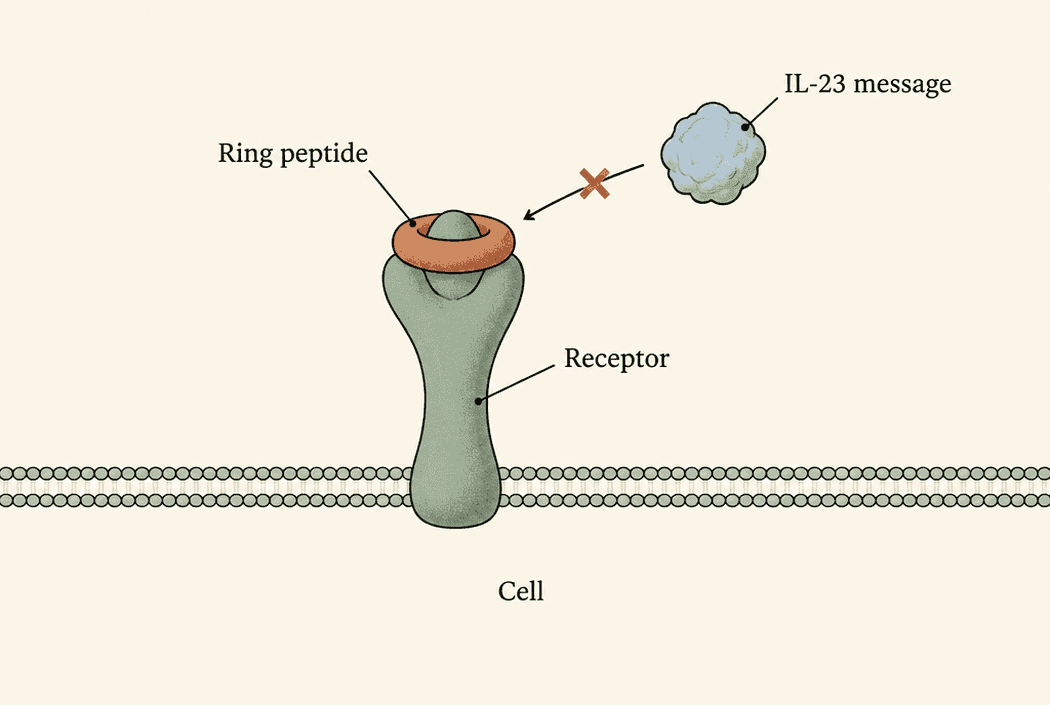
Icotrokinra is a lab-made peptide that attaches to the interleukin-23 receptor, a protein that receives one of the immune system's chemical messages. In laboratory studies, icotrokinra blocks signalling through that receptor. Receptor studies measure how molecules attach and how cell signals change. Those measurements alone cannot show what happens to a person's health.
01Peptide identityContents
When a scratch turns red and puffy, your immune system has spotted trouble. Under that visible change, cells pass messages to each other through proteins on their surfaces. Learning how those messages work is part of peptide science.
You may come across icotrokinra while reading about immune research. The best place to start is the question behind each test. Did a molecule attach? Did a cell signal change? Or did researchers measure a change in people? Each question gives a different kind of evidence.
Key facts
| Name | Icotrokinra |
|---|---|
| Research identifier | JNJ-77242113 (Fourie et al., 2024) |
| Class | Synthetic macrocyclic peptide (Fourie et al., 2024) |
| Chain length | 13 amino acids (Knight et al., 2025) |
| Target | IL-23 receptor (Fourie et al., 2024) |
| Evidence types | Receptor binding; cell signaling; human biomarkers |
What kind of peptide is icotrokinra?
Icotrokinra is a peptide made in a lab, not a natural immune messenger. Its structure includes a ring. Chemists call this macrocyclic, which means part of the chain loops round to form a large ring. The chain contains 13 amino acids, the building blocks joined together in every peptide. The name refers to one specific molecule, not a whole family of immune compounds. Calling something a peptide describes its chemistry. That label does not name its target or explain all of its effects. It also does not show that another peptide will behave the same way.
What a peptide bond is explains the difference between a chain and its building blocks. Sharing the same building material does not make different molecules interchangeable.
What does the IL-23 receptor normally do?
The IL-23 receptor lets certain immune cells respond to interleukin-23, or IL-23. IL-23 is a cytokine: a protein message passed between cells. A 2002 study showed that the receptor system has two parts, IL-23R and a partner called IL-12Rβ1. A cell needs this matching receptor machinery to respond to the message. The message attaches outside the cell, and the receptor connects to signalling proteins inside. So the message and the receiver have separate jobs. Think of IL-23 as a finger pressing a doorbell. The receptor is the doorbell, which carries the press inside and starts the ringing.
Receptors make cell communication selective. A message can be present without every nearby cell responding the same way. What peptides do gives a broader introduction to signals and their targets.
What do icotrokinra receptor-binding studies measure?
Receptor-binding studies measure how a molecule attaches to a receptor under set lab conditions. In 2024, researchers used surface plasmon resonance to study icotrokinra. This method tracks binding on a sensor surface. They tested icotrokinra against the part of IL-23R that sits outside the cell. Binding affinity describes how strongly two molecules hold together. A binding result is not a whole-cell response. The test separates one interaction from the many events that follow in living tissue. The result only keeps its meaning alongside the receptor sample and test conditions that produced it.
Using just one piece of the receptor makes a narrow question easier to study. But removing the rest of the cell also removes most of the biology around it. A clean binding result cannot fill in that missing context.
How do cell studies differ from receptor-binding tests?
Cell studies measure what a cell does after a signal reaches its receptor, not just whether something attaches. In the 2024 icotrokinra research, scientists measured STAT3 phosphorylation after IL-23 stimulation. They compared this with responses to IL-12, a related signal. STAT3 is a protein that carries signals inside cells. Phosphorylation means adding a small phosphate tag that changes how a protein behaves. Comparing related signals tests selectivity: is a change tied more closely to the intended pathway than to its neighbour? A cell result still applies only to the cells and conditions tested.
What can a receptor structure reveal?
A receptor structure shows how molecular parts fit together. It does not show how a person will respond. In 2024, researchers used electron cryo-microscopy to look at assembled IL-23 receptor complexes. This method freezes samples and images them with a beam of electrons. Structures like this show where parts touch and how a signal meets its receiver. But that published structure is not a picture of icotrokinra attached to its target. A general picture of the pathway and a picture with one particular compound in place answer different questions. Each needs a clear label.
Evidence limits
What do human biomarker studies add, and what remains unproven?
Human biomarker studies add measurements from people. But a biomarker change alone cannot prove a health outcome. A biomarker is a measurable sign of a process in the body. A 2025 study examined proteins in blood and in skin samples from people with psoriasis in an icotrokinra study. Those samples give a human setting that an isolated receptor lacks. Linking a protein change to a clinical result still needs its own evidence. The receptor experiments do not give a rule that predicts each person's response. Nor do they show that all inflammation follows the same pathway.
Peptide identity is another separate question. Mass spectrometry and peptide identity explains how chemists identify a molecule. A matching molecule does not by itself repeat a study's biological evidence.
Comparison
The icotrokinra and IL-23 receptor studies named on this page, grouped by what each one measured. Cells restate published findings only. Not a guide to use.
| What was studied | What was measured | What it does not show | |
|---|---|---|---|
| Receptor parts, 2002 | The natural IL-23 receptor system | Its two parts, IL-23R and IL-12Rβ1 | Anything about icotrokinra |
| Binding, 2024 | Icotrokinra and the outer part of IL-23R | How strongly the two attach | A whole-cell response |
| Cell signals, 2024 | Cells given IL-23 or IL-12 | STAT3 phosphorylation | The response in every setting |
| Receptor structure, 2024 | Assembled IL-23 receptor complexes | How the parts fit together | Icotrokinra attached to its target |
| Human samples, 2025 | Blood and skin from people with psoriasis | Changes in proteins | A clinical result for each person |
FAQ
Is icotrokinra a peptide or an antibody?
Icotrokinra is a synthetic peptide with a chain of 13 amino acids. Calling it a peptide describes its chemistry. That does not make it the same as an antibody that targets a related immune signal.
Does icotrokinra bind IL-23 or its receptor?
Icotrokinra binds the IL-23 receptor. The immune message and the receptor that receives it are different proteins.
Is a blood biomarker the same as a receptor-binding result?
No. A blood biomarker is a measured sign of biology in a blood sample. A receptor-binding result describes how two molecules interact. The 2025 human sample study sits at a different level of evidence from an isolated receptor experiment.
Does a receptor diagram show the exact shape of icotrokinra?
No. A pathway diagram explains how signals and receptors relate. An exact molecular shape needs structural evidence for the molecule shown. The 2024 structure study looked at IL-23 receptor assemblies, which should not be presented as structures with icotrokinra attached.
More in this hub
- Which peptides are approved in Australia and by the FDA?
- What are peptides? Meaning, medicines, safety and legal status in Australia
- What is a peptide bond? Peptide structure, chemistry and synthetic peptides explained
- Citrullinated peptide antibodies: what anti-CCP is, why the test peptide is cyclic and how it is pronounced
- Peptide vs protein: what is the difference? Peptides compared with proteins, hormones, collagen and approved medicines
- What do peptides do? What published studies found
- Peptide side effects: what studies and regulators have recorded
- Do peptides show up on drug tests? How peptides are tested and labelled
- What have collagen peptide studies measured about muscle?
- What is a signal peptide, and how does it direct a protein?
- What is carnosine, and what do studies measure?
- What is CGRP, and how does its signalling work?
- What is irisin, and how is it studied?
- What is lunasin, and what have studies measured?
- What is pramlintide, and how does amylin signalling work?
- What is peptide YY, and what do studies measure?
- What does TAT-DATNT refer to in peptide research?
Citations
5 sourcesFourie AM, Cheng X, Chang L, et al. Scientific Reports. 2024;14:17515.
doi:10.1038/s41598-024-67371-5Knight B, Tammara B, Modi NB, et al. Dermatology and Therapy. 2025;15:2495–2520.
doi:10.1007/s13555-025-01454-7Parham C, Chirica M, Timans J, et al. The Journal of Immunology. 2002;168(11):5699–5708.
doi:10.4049/jimmunol.168.11.5699Bloch Y, Felix J, Merceron R, et al. Nature Structural & Molecular Biology. 2024;31:591–597.
doi:10.1038/s41594-023-01190-6Strawn D, Krueger JG, Bissonnette R, et al. JCI Insight. 2025;10(24):e193563.
doi:10.1172/jci.insight.193563
Form Laboratories supplies research-use-only reference material. This article is an educational summary of published third-party literature. It is not medical advice, not a use instruction, and research material is not for human or animal use.