
Hub · Peptide Science
What is SS-31, and did its trial measure weight loss?
SS-31's Barth syndrome trial did not list weight loss as an outcome. The trial register names walking distance and fatigue as its main measures. SS-31, also called elamipretide, is a peptide studied in cell energy research. The FDA's approval concerned muscle strength in Barth syndrome. Those records cannot show whether SS-31 changes body fat. Both records were checked on 17 October 2026.
01SS-31 explainedContents
A knee strength test and a bathroom scale answer different questions. Yet both can appear under a broad heading like metabolism. That word covers the body's many chemical tasks. Before you judge a claim, check what the study actually measured. The peptide science hub explains how to read these separate kinds of evidence.
This guide from Form Laboratories follows one named trial, TAZPOWER. It pairs the trial register with the FDA's account of its findings. You can trace each claim back to the record it describes.
Key facts
| Names | SS-31 and elamipretide name the same peptide (Thompson et al., 2021) |
|---|---|
| Trial | TAZPOWER; NCT03098797 (ClinicalTrials.gov; checked 17 October 2026) |
| Main measures | Walking distance and fatigue score (ClinicalTrials.gov, record updated 16 April 2024) |
| Approval record | FDA announcement dated 19 September 2025; checked 17 October 2026 |
What is SS-31, also called elamipretide?
SS-31 is a peptide, a short chain of amino acids. Amino acids are the small units that also form proteins. Thompson and colleagues describe SS-31 in their 2021 trial paper. It binds to cardiolipin, a fat within the cell's energy parts. Those parts are called mitochondria. A proposed action inside cells explains a research question. It cannot, by itself, show a change in someone's weight.
The paper links Barth syndrome to faults in how cardiolipin forms. This rare inherited disease can affect the heart and muscles. What are peptides? explains the chain structure. What do peptides do? separates a molecule's build from its role. Shared terms do not make all peptides alike.
What did the TAZPOWER trial measure?
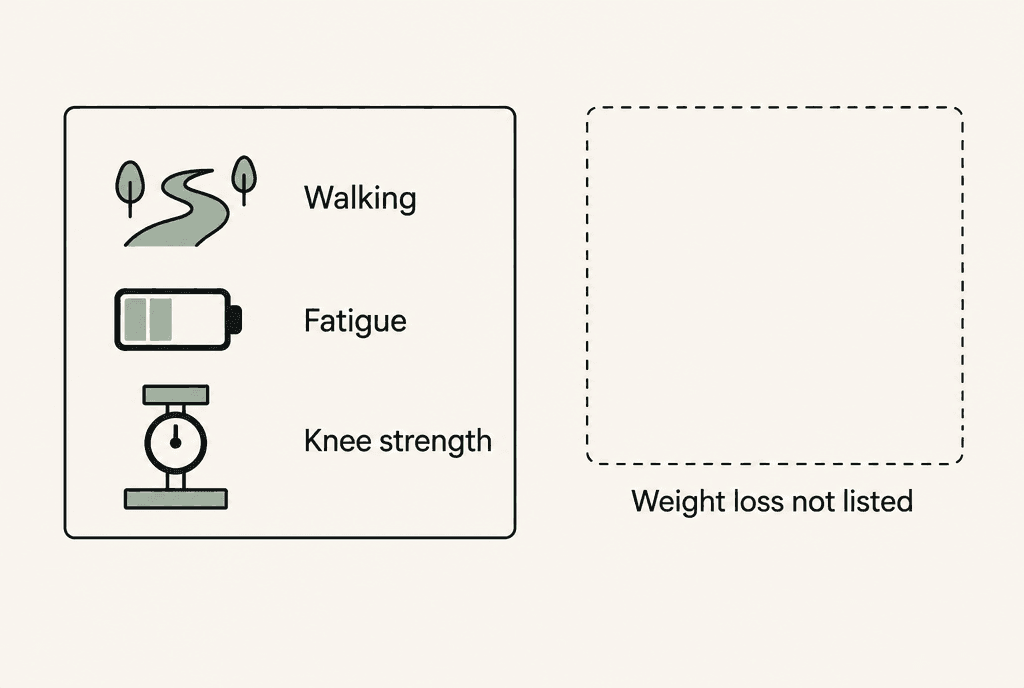
TAZPOWER's main measures were walking distance and a fatigue score. Fatigue means feeling worn out. The ClinicalTrials.gov record names a six-minute walk test. It also lists muscle strength, balance and other health scores. These are separate measures of movement and symptoms. The register was last updated on 16 April 2024. Its listed outcomes were checked on 17 October 2026.
The record is ClinicalTrials.gov study NCT03098797. An outcome is the thing a trial measures to answer its question. A main outcome is chosen as a central test. Other listed outcomes explore more questions. A result should keep the name of its measure attached.
Did TAZPOWER list weight loss or body fat as an outcome?
TAZPOWER listed neither weight loss nor body fat as an outcome. That finding comes from its ClinicalTrials.gov outcome list, checked 17 October 2026. It does not mean weight could never have been recorded. A study can record body size to describe its participants. Such a record differs from testing whether a treatment causes weight loss. A strength result cannot fill that evidence gap.
Think of the trial as a set of labelled boxes. Walking distance belongs in one box, and strength in another. A weight-loss claim needs its own matching test and result. Missing evidence does not establish either an effect or no effect. It leaves the weight question unanswered by this trial.
Why do the controlled and open-label results need separate labels?
The controlled part compared elamipretide with a placebo, a dummy treatment. Thompson and colleagues' 2021 paper reports no clear difference on either main measure. Later, participants knew they were receiving elamipretide. This is called an open-label extension. The FDA snapshot reports strength gains during that later period. The two parts answer different questions because the later part lacked a matching placebo group.
The published TAZPOWER paper describes both parts. The FDA trial snapshot separates their strength findings too. Both were checked on 17 October 2026. Without a matching control, other changes over time are harder to rule out. The later finding should keep that limit beside it.
What did the FDA approval of elamipretide concern?
The FDA announced accelerated approval of elamipretide on 19 September 2025. Its medicine name is Forzinity. The decision concerned muscle strength in people with Barth syndrome. The key measure was strength in the muscle that straightens the knee. The announcement requires a further controlled trial to confirm patient outcomes. This account was checked on 17 October 2026. It is not a weight-loss approval.
The FDA approval announcement explains the decision. Accelerated approval can rely on a measure expected to predict patient outcomes. Here, knee strength was that measure. The required follow-up must test whether that strength change translates into changes that matter to patients.
Evidence limits
What can these SS-31 records not tell us?
These SS-31 records cannot establish weight loss in the wider public. A trial in a rare disease does not answer every health question. Nor does a proposed cell action establish lasting changes in body fat. The FDA snapshot also reports allergic reactions, including serious cases. This record was checked on 17 October 2026. Approval for a named disease does not establish safety for other purposes.
This page checks the listed outcomes of one named trial. It does not claim to cover every elamipretide study. Research material is not the approved medicine. It is not for human or animal use. The missing weight-loss outcome should remain clear beside any discussion of muscle findings.
Comparison
Match each claim to its actual measure. Sources: ClinicalTrials.gov NCT03098797 and the FDA trial snapshot; checked 17 October 2026.
| Question | Measure in the record | What the record can address |
|---|---|---|
| Walking | Distance in a six-minute walk test | Walking performance; ClinicalTrials.gov |
| Fatigue | Barth syndrome symptom score | Reported tiredness; ClinicalTrials.gov |
| Muscle strength | Force from the muscles that straighten the knee | Strength findings in each study part; FDA snapshot |
| Weight loss | No weight-loss or body-fat outcome listed | Not answered by this outcome list; ClinicalTrials.gov |
FAQ
Are SS-31 and elamipretide different peptides?
No. Thompson and colleagues' 2021 paper uses both names for the same peptide. Forzinity is the medicine name in the FDA's record.
Does a change in muscle strength show fat loss?
No. Strength describes force from a muscle. Body fat is a different measure. One cannot stand in for the other.
Does a missing weight-loss outcome mean SS-31 cannot affect weight?
No. A missing outcome leaves the question open. It gives no direct result to support a claim either way.
Can findings from Barth syndrome apply to everyone?
These records cannot establish that. The disease, the study design and the chosen measures limit what can be concluded. Broader claims need evidence that matches the people and outcome in the claim.
More in this hub
- Is SLU-PP-332 a peptide, and what harm record exists?
- Which peptides are approved in Australia and by the FDA?
- What are peptides? Meaning, medicines, safety and legal status in Australia
- What is a peptide bond? Peptide structure, chemistry and synthetic peptides explained
- Citrullinated peptide antibodies: what anti-CCP is, why the test peptide is cyclic and how it is pronounced
- Peptide vs protein: what is the difference? Peptides compared with proteins, hormones, collagen and approved medicines
- What do peptides do? What published studies found
- Peptide side effects: what studies and regulators have recorded
- Do peptides show up on drug tests? How peptides are tested and labelled
- What have collagen peptide studies measured about muscle?
- What is a signal peptide, and how does it direct a protein?
- What is carnosine, and what do studies measure?
- What is CGRP, and how does its signalling work?
- What is icotrokinra, and what do receptor studies measure?
- What is irisin, and how is it studied?
- What is lunasin, and what have studies measured?
- What is pramlintide, and how does amylin signalling work?
- What is peptide YY, and what do studies measure?
- What does TAT-DATNT refer to in peptide research?
Citations
1 sourcesThompson WR, Hornby B, Manuel R, et al. Genetics in Medicine. 2021;23:471–478; TAZPOWER trial and open-label extension.
doi:10.1038/s41436-020-01006-8
Continue
Explore peptide scienceForm Laboratories supplies research-use-only reference material. This article is an educational summary of published third-party literature. It is not medical advice, not a use instruction, and research material is not for human or animal use.